Philosopher
Tsongkhapa
1357–1419
Also known as Tsongkhapa Losang Drakpa, Tsong kha pa Blo bzang grags pa
Tibetan philosopher whose reading of Madhyamaka joined a robust realism about the conventional world to emptiness, and whose school became the Gelug.
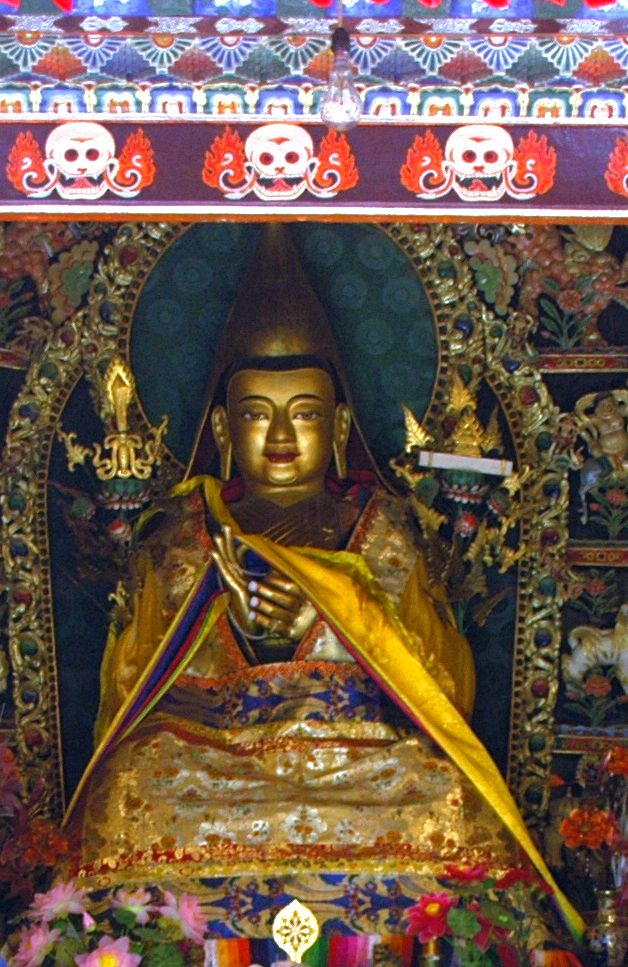

Tsongkhapa was born in October 1357 in Tsongkha, in the Amdo region of Tibet, from which he took his name. He studied in the main scholarly traditions of his time, the Sangphu tradition founded by Ngok Loden Sherab and the Sakya tradition, and found his principal teacher in Rendawa. When he came to central Tibet, everyone was debating Dolpopa’s ‘Great Middle Way’, which he came to reject.
A prolific author of over 300 works, he joined theory and practice, study and meditation, and the tantric tradition with monastic discipline. He was strongly influenced by the logic and epistemology of Dignāga and Dharmakīrti. On his death in 1419 he gave his yellow hat to his disciple Gyaltsab as a sign of succession; the school that followed him became known as the Gelug.
Key ideas
- Realism about the conventional
- Tsongkhapa’s main contribution was to show how one can be a robust realist about the conventional world, and make sense of knowledge, within a world that is ultimately illusory, without sliding into nihilism.
- Even emptiness is conventional
- The emptiness of intrinsic existence is the ultimate truth, yet even that is true only conventionally. Things are both conventionally and ultimately true, as his analysis of dependent origination shows.
- Candrakīrti over Bhāviveka
- He distinguished Candrakīrti’s ‘Consequentialist’ (Prāsaṅgika) reading of Nāgārjuna, which he held correct, from Bhāviveka’s ‘Autonomist’ (Svātantrika) reading, which he held mistaken.
- Nested ethical codes
- Ethics depends on the person and the situation. There are three codes, for followers of the basic Buddhist rules, for bodhisattvas, and for tantric practitioners, each higher code containing the rules of the lower.
- Tradition
- Tibetan
- Region
- Amdo and central Tibet
- Schools
- Madhyamaka
- Period
- Classical
- Themes
- What is ultimately real
Influences
Influenced by
- Bhāvivekac. 500 – c. 570 CEcriticised
- Candrakīrtic. 600 – c. 650 CE
- Dharmakīrtic. 600 – c. 660 CE
- Dolpopa1292–1361criticised
Tsongkhapa1357–1419
Influenced
Influenced by
- Bhāvivekac. 500 – c. 570 CEcriticised
- Candrakīrtic. 600 – c. 650 CE
- Dharmakīrtic. 600 – c. 660 CE
- Dolpopa1292–1361criticised
Tsongkhapa1357–1419
Influenced
Where these links come from
- Tsongkhapa argued against Bhāviveka. Source: Gareth Sparham and Chandra Chiara Ehm, Tsongkhapa, Stanford Encyclopedia of Philosophy
- Tsongkhapa drew on Candrakīrti. Source: Gareth Sparham and Chandra Chiara Ehm, Tsongkhapa, Stanford Encyclopedia of Philosophy
- Tsongkhapa drew on Dharmakīrti. Source: Gareth Sparham and Chandra Chiara Ehm, Tsongkhapa, Stanford Encyclopedia of Philosophy
- Tsongkhapa argued against Dolpopa. Source: Gareth Sparham and Chandra Chiara Ehm, Tsongkhapa, Stanford Encyclopedia of Philosophy
- Gorampa argued against Tsongkhapa. Source: Constance Kassor, Gorampa, Stanford Encyclopedia of Philosophy
Key works
- The Great Treatise on the Stages of the Path to Enlightenment (Lam rim chen mo), 1402
- Essence of Eloquence (Legs bshad snying po), 1407
Sources
- Gareth Sparham and Chandra Chiara Ehm, Tsongkhapa, Stanford Encyclopedia of Philosophy