Philosopher
Sophie de Grouchy
1764–1822
Also known as Marie-Louise-Sophie de Grouchy, Marquise de Condorcet, Sophie de Condorcet
French philosopher of the Revolution whose Letters on Sympathy traced morality to the sympathy we learn in infancy, and argued from it for equality, republican liberty and reform of marriage law.
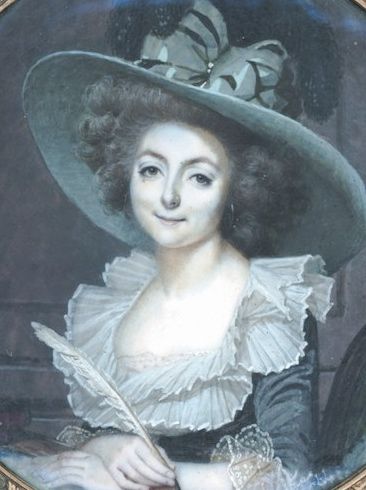

Sophie de Grouchy, born at the Château de Meulan in 1764, was educated at home, sharing her brothers’ tutors; at a convent finishing school she read Rousseau and Voltaire and became an atheist. At twenty-two she married the mathematician and philosopher Condorcet, and their salon at the Paris Mint brought together the political and literary world. In 1791, with Condorcet, Thomas Paine, Brissot and others, she started a journal to promote republican thought in France.
Her one book under her own name, the Letters on Sympathy, was drafted around 1791 and published in 1798, appended to her translation of Adam Smith’s Theory of Moral Sentiments. She also wrote republican journalism anonymously and helped write and edit Condorcet’s last work, the Sketch of Human Progress. She died in 1822. Long overlooked, her work has been recovered as part of the wider effort to restore women philosophers to the history of the subject.
Key ideas
- Where sympathy begins
- Adam Smith described sympathy and its effects but not its first cause. Grouchy traced it to infancy, to a baby’s pain at being parted from its nurse and its pleasure at their reunion; from there we learn to feel the pain of others, even strangers.
- Virtue grows from sympathy
- Both moral and political virtue grow out of sympathy: the ability and the tendency to feel another’s pain and want to relieve it. With the right education it develops into moral sentiment, which joined with abstract ideas yields the idea of justice.
- Inequality blinds sympathy
- We can feel for someone only if we see them as a human being as capable of pain as ourselves. Extreme inequality prevents this, so a republic in which every citizen is owed equal respect cannot tolerate it.
- Marriage and the law
- Grouchy argued for divorce, for marriage contracts that are short and renewable, and for the rights of illegitimate children and their mothers to be made clear, drawing in part on Montesquieu’s analysis of Roman law.
- Tradition
- Western
- Region
- Paris, France
- Period
- Late modern
Influences
Influenced by
Sophie de Grouchy1764–1822
Influenced by
Sophie de Grouchy1764–1822
Where these links come from
- Sophie de Grouchy drew on John Locke. Source: Sandrine Berges, Sophie de Grouchy, Stanford Encyclopedia of Philosophy
- Sophie de Grouchy drew on Montesquieu. Source: Sandrine Berges, Sophie de Grouchy, Stanford Encyclopedia of Philosophy
- Sophie de Grouchy drew on and argued against Adam Smith. Source: Sandrine Berges, Sophie de Grouchy, Stanford Encyclopedia of Philosophy
Key works
- Letters on Sympathy (Huit lettres sur la sympathie), 1798
Sources
- Sandrine Berges, Sophie de Grouchy, Stanford Encyclopedia of Philosophy