Philosopher
Franz Rosenzweig
1886–1929
German-Jewish thinker whose Star of Redemption, begun on postcards from the Balkan front, joined philosophy and theology in a 'new thinking' built on speech, time and revelation.
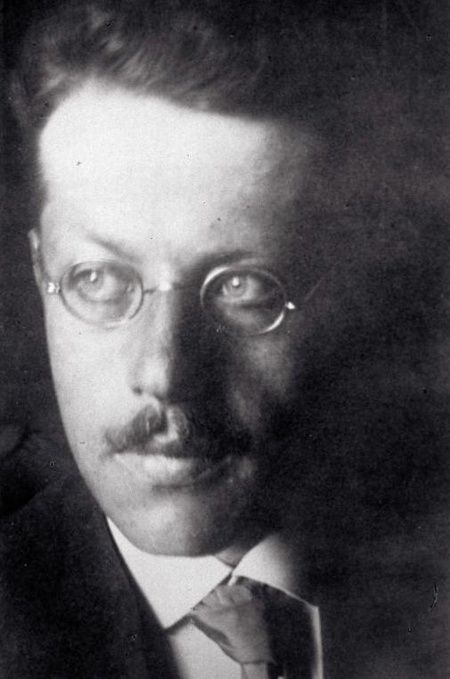

Franz Rosenzweig grew up in an assimilated Jewish home in Kassel, studied medicine and then history and philosophy at Freiburg, and wrote a dissertation on the origins of Hegel’s political philosophy. In 1913 he came close to converting to Christianity, then turned decisively back to Judaism, studying with the neo-Kantian Hermann Cohen in Berlin.
He began The Star of Redemption, perhaps the finest achievement of modern Jewish philosophy, on army postcards he mailed home while serving in the Balkans, and later gave up an academic career to found the Lehrhaus, a centre of Jewish adult education in Frankfurt. Diagnosed with ALS in 1922, he kept writing and translating, latterly by indicating letters on a special typewriter that his wife Edith interpreted, and worked with Martin Buber on a German translation of the Bible. He died in 1929. His thought left a mark on twentieth-century existentialism.
Key ideas
- The new thinking
- German Idealism had brought a 2,500-year arc of philosophy, begun by the pre-Socratics, to its completion, and in doing so exposed habits that kept philosophers from the knowledge they sought. Rosenzweig’s ‘new thinking’ was meant to turn philosophy and theology, together, in a new direction.
- Speech-thinking
- Speech is bound more closely to time than abstract reasoning is. Through its tenses, names, stories, first names and songs we grasp how God, world and self are related, in creation, revelation and redemption as we live them in time.
- Revelation as a call
- Revelation is a call from the Absolute other, an account that helped shape the course of Jewish and Christian theology in the early twentieth century.
- I and You
- The relation between an ‘I’ and a ‘You’ who addresses it is what makes a self, and it also has redemptive effects on community.
Influences
Influenced by
Franz Rosenzweig1886–1929
Influenced
Influenced by
Franz Rosenzweig1886–1929
Influenced
Where these links come from
- Franz Rosenzweig drew on and argued against G. W. F. Hegel. Source: Benjamin Pollock, Franz Rosenzweig, Stanford Encyclopedia of Philosophy
- Franz Rosenzweig studied with and drew on Hermann Cohen. Source: Benjamin Pollock, Franz Rosenzweig, Stanford Encyclopedia of Philosophy
- Emmanuel Levinas drew on Franz Rosenzweig. Source: Bettina Bergo, Emmanuel Levinas, Stanford Encyclopedia of Philosophy
Key works
- Hegel and the State (Hegel und der Staat), 1920
- The Star of Redemption (Der Stern der Erlösung)
Sources
- Benjamin Pollock, Franz Rosenzweig, Stanford Encyclopedia of Philosophy