Philosopher
Emmanuel Levinas
1905–1995
Also known as Emmanuel Lévinas
Lithuanian-born French philosopher who argued that ethics, the encounter with another person, is first philosophy, before metaphysics or ontology; also a reader of the Talmud.
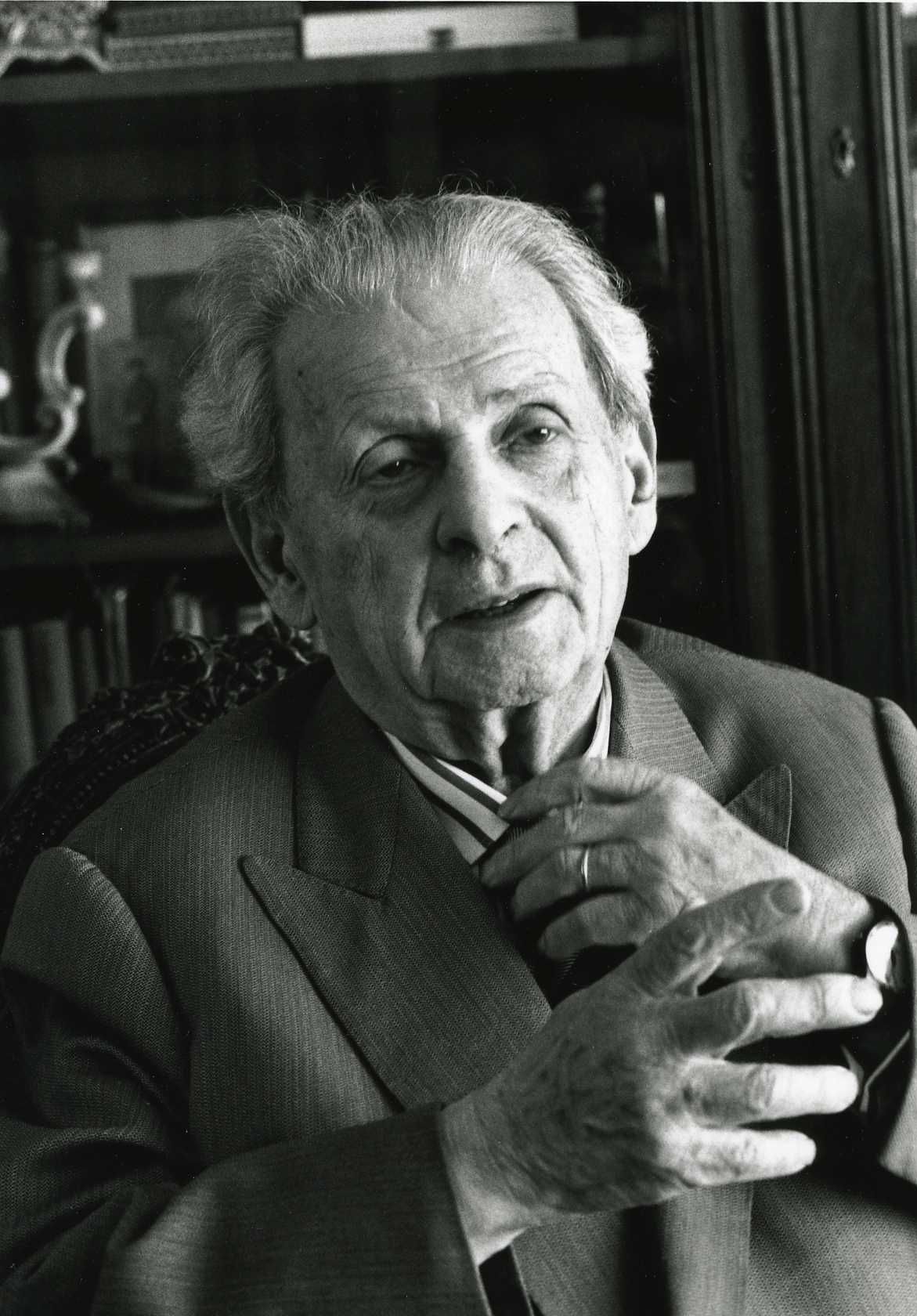

Emmanuel Levinas was born in Kaunas, Lithuania, in 1905. He studied philosophy in Strasbourg from 1923, where Maurice Blanchot became a close friend, and in 1928–1929 studied with Husserl in Freiburg and attended Heidegger’s seminar. His thesis on Husserl’s theory of intuition followed in 1930, and he co-translated Husserl’s Cartesian Meditations into French. Naturalised French, he enlisted in 1939, was captured in 1940 and held in a labour camp for officers, while his family in Lithuania was murdered.
After the war he became director of the École Normale Israélite Orientale in Paris, gave Talmudic readings from 1957, and published Totality and Infinity in 1961, a book in which, he said, Rosenzweig’s Star of Redemption was too present to be cited. He later taught at Nanterre and the Sorbonne. He died in 1995.
Key ideas
- Ethics as first philosophy
- Traditionally first philosophy meant metaphysics or theology, and Heidegger made it fundamental ontology. Levinas argued that ethics should be first, not as an ethical theory but as a description of what happens when one meets another person.
- Responsibility before thought
- Meeting another person calls forth spontaneous responsibility for them, at a level below cognition, through our embodied sensibility. That level comes before both reflection and practical interest.
- Beyond totality
- His work is a running critical dialogue with Husserl, Heidegger and Hegel: it extends Husserl’s method of suspending concepts to show experience as it arises, and draws on Heidegger’s being-in-the-world, while opposing the primacy of ontology.
- Tradition
- Jewish
- Region
- Kaunas, Strasbourg and Paris
- Schools
- Phenomenology
- Themes
- The self
Influences
Influenced by
- G. W. F. Hegel1770–1831criticised
- Edmund Husserl1859–1938teacher
- Franz Rosenzweig1886–1929
- Martin Heidegger1889–1976criticised
Emmanuel Levinas1905–1995
Influenced by
- G. W. F. Hegel1770–1831criticised
- Edmund Husserl1859–1938teacher
- Franz Rosenzweig1886–1929
- Martin Heidegger1889–1976criticised
Emmanuel Levinas1905–1995
Where these links come from
- Emmanuel Levinas argued against G. W. F. Hegel. Source: Bettina Bergo, Emmanuel Levinas, Stanford Encyclopedia of Philosophy
- Emmanuel Levinas studied with and drew on Edmund Husserl. Source: Bettina Bergo, Emmanuel Levinas, Stanford Encyclopedia of Philosophy
- Emmanuel Levinas drew on Franz Rosenzweig. Source: Bettina Bergo, Emmanuel Levinas, Stanford Encyclopedia of Philosophy
- Emmanuel Levinas drew on and argued against Martin Heidegger. Source: Bettina Bergo, Emmanuel Levinas, Stanford Encyclopedia of Philosophy
Key works
- Totality and Infinity (Totalité et infini), 1961
- Difficult Freedom (Difficile liberté), 1963
- Otherwise than Being or Beyond Essence (Autrement qu'être ou au-delà de l'essence), 1974
Sources
- Bettina Bergo, Emmanuel Levinas, Stanford Encyclopedia of Philosophy