Philosopher
Elizabeth Cady Stanton
1815–1902
American feminist theorist and the philosopher of the women's suffrage movement, author of the Declaration of Sentiments and, late in life, the critical Woman's Bible.
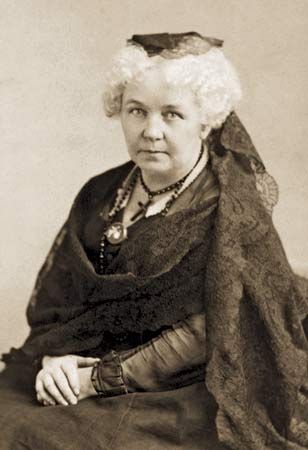

Elizabeth Cady was born in Johnstown, New York, in 1815, the daughter of a prominent lawyer and judge who often told her she should have been a boy. She studied Greek, won prizes at the local academy and, from the young men training in her father’s law office, learned the legal theory of Coke, Blackstone and Bentham. She first met women’s rights activists in 1840, at the antislavery convention in London, where she had gone with her new husband, the abolitionist Henry Stanton.
Moved by the burdens unjust laws placed on women without means, she organised the Seneca Falls convention with Lucretia Mott. With Susan B. Anthony, the movement’s strategist, she was its philosopher, motivated by Enlightenment ideals of equality and individual autonomy and well read in Wollstonecraft and, in time, in both John Stuart Mill and Harriet Taylor Mill. A lifelong religious sceptic, she died in New York in 1902, never having cast a vote.
Key ideas
- The Declaration of Sentiments
- For the first women’s rights convention, at Seneca Falls in 1848, she wrote a Declaration of Sentiments modelled on the Declaration of Independence; nearly seventy of the more than two hundred who came signed it.
- Every front at once
- Unlike Susan B. Anthony, who saw the vote as the key to all other rights, Stanton fought for women’s equality on every front at once: property, education, employment, divorce and custody, as well as the franchise.
- The Woman’s Bible
- With a committee of women scholars she examined the passages of Scripture about women, reading Eve’s story critically, writing of Jesus as a man, and drawing out the roles of women such as Miriam and Deborah.
- Tradition
- Western
- Region
- New York
- Period
- Late modern
- Themes
- Women and gender
Influences
Where these links come from
- Elizabeth Cady Stanton drew on Mary Wollstonecraft. Source: Dorothy Rogers, Elizabeth Cady Stanton, Internet Encyclopedia of Philosophy
- Elizabeth Cady Stanton drew on John Stuart Mill. Source: Dorothy Rogers, Elizabeth Cady Stanton, Internet Encyclopedia of Philosophy
Key works
- Declaration of Sentiments, 1848
- Solitude of Self, 1892
- The Woman's Bible, 1895
Sources
- Dorothy Rogers, Elizabeth Cady Stanton, Internet Encyclopedia of Philosophy