Philosopher
Catharine Macaulay
1731–1791
Also known as Catharine Sawbridge, Catharine Macaulay Graham
Republican historian and philosopher, whose History of England defended the people's liberties against the Stuarts, and whose Letters on Education argued for educating the sexes alike.
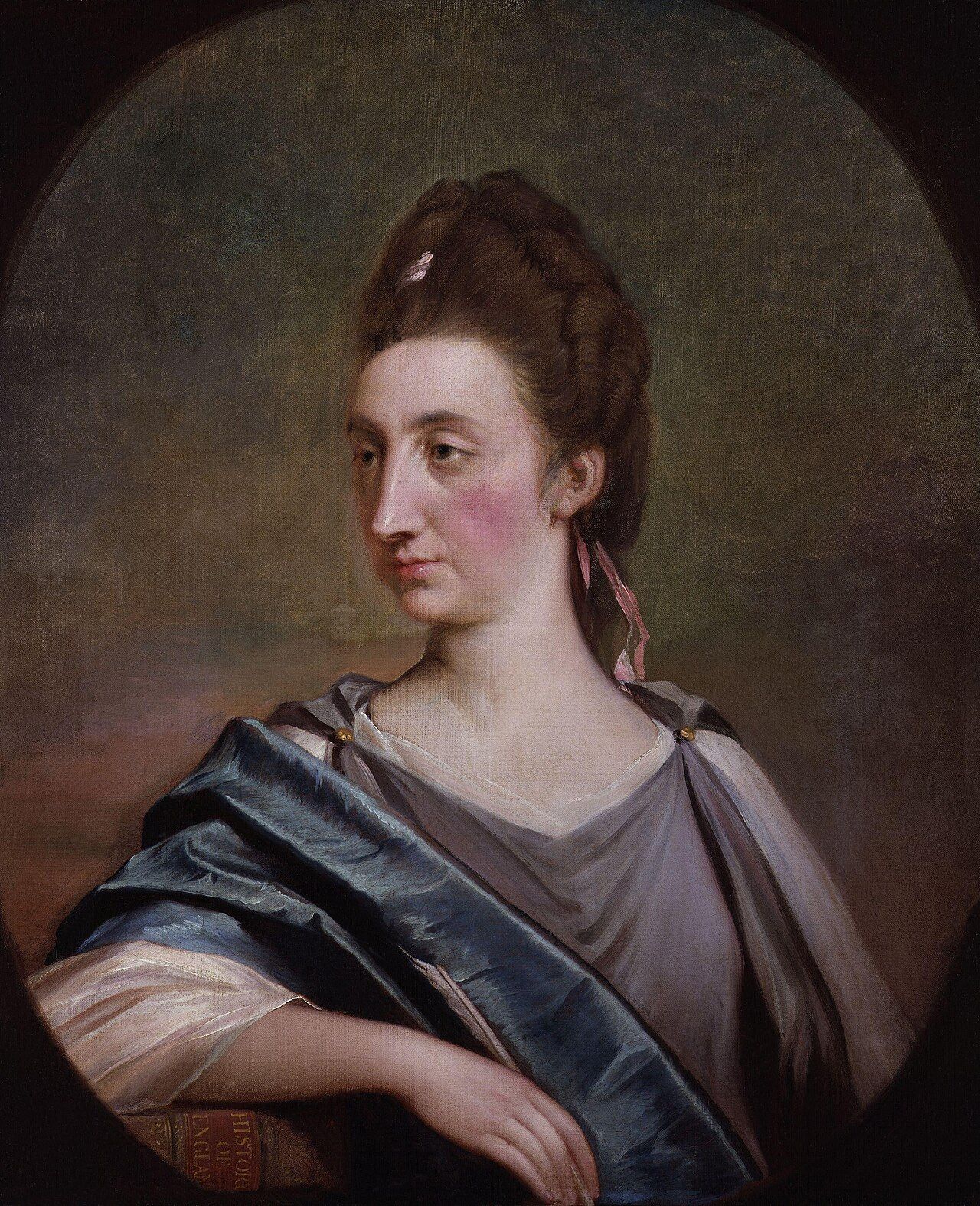
_by_Robert_Edge_Pine.jpg)
Catharine Sawbridge was born in Kent in 1731 and, by her own account, fell in love with the histories of the Greek and Roman republics as a girl, reading in her father’s library. Her eight-volume History of England, published between 1763 and 1783, made her famous. She was associated with the Bluestocking circle and painted among the “Nine Living Muses of Great Britain”, but was too radical for many of its members.
She wrote a further history in letters, on the period after 1688, and pamphlets defending the right to petition and arguing for copyright. After American independence she was welcomed in the United States as an advocate of the principles on which it was founded. She died in 1791.
Key ideas
- Republican liberty
- Her History of England told the story of the Civil War as the Commons’ struggle to keep their liberties against the absolutism of the Stuarts, and affirmed the people’s right to depose their monarch.
- Against Hobbes and Burke
- In political pamphlets she refuted the monarchism of Hobbes and the conservatism of Burke, and she criticised the British government’s policy towards the American colonies.
- Moral necessity
- In A Treatise on the Immutability of Moral Truth she developed a doctrine of the will that she called “moral necessity”.
- No difference of sex
- Letters on Education argued that there is “no characteristic difference in sex”, an argument that Mary Wollstonecraft reviewed and was deeply influenced by.
- Tradition
- Western
- Region
- England
- Period
- Early modern
- Themes
- How to govern
Influences
Influenced by
Catharine Macaulay1731–1791
Influenced
Influenced by
Catharine Macaulay1731–1791
Influenced
Where these links come from
- Catharine Macaulay argued against Thomas Hobbes. Source: Karen Green, Catharine Macaulay, Stanford Encyclopedia of Philosophy
- Catharine Macaulay argued against David Hume. Source: Karen Green, Catharine Macaulay, Stanford Encyclopedia of Philosophy
- Mary Wollstonecraft drew on Catharine Macaulay. Source: Karen Green, Catharine Macaulay, Stanford Encyclopedia of Philosophy
Key works
- The History of England from the Accession of James I to that of the Brunswick Line, 1763
- A Treatise on the Immutability of Moral Truth, 1783
- Letters on Education, 1790
Sources
- Karen Green, Catharine Macaulay, Stanford Encyclopedia of Philosophy