Philosopher
Rosa Luxemburg
1871–1919
Polish-born Marxist theorist of capitalism, imperialism and revolutionary democracy, who defended freedom as collective self-rule and was murdered in Berlin in 1919.
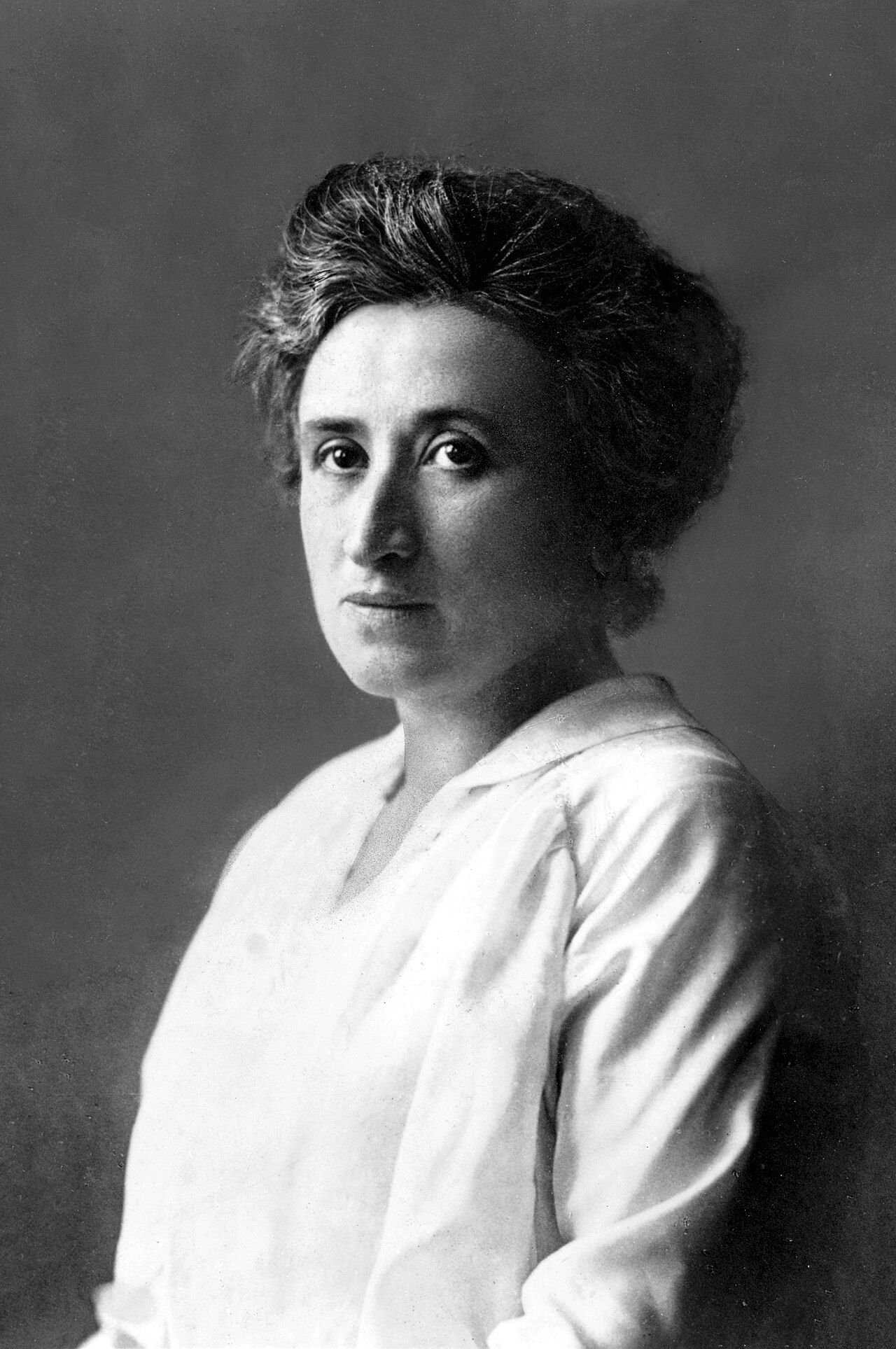

Rosa Luxemburg was born in 1871 in Zamość, in Russian-occupied Poland, into an assimilated Jewish family, and grew up in Warsaw. Facing arrest, she was smuggled out in 1889 to Zurich, where she wrote a doctoral thesis on Poland’s industrial development and, with her partner Leo Jogiches, fought for the SDKP, a Polish Marxist party opposed to the call for Polish independence.
In Germany she made her name in the revisionist controversy, published The Accumulation of Capital in 1913, and debated Lenin on the relation of party and masses. A colleague called her the most brilliant intellect among the scholarly successors of Marx and Engels. Imprisoned during the First World War, she welcomed the Russian revolution. With Karl Liebknecht and others she founded the Spartakus group; on 15 January 1919, amid the January uprising in Berlin, she was arrested and shot, and her body thrown into the Landwehr Canal.
Key ideas
- Accumulation and imperialism
- Marx had modelled capitalism as a closed system. Luxemburg argued that even mature capitalism depends on non-capitalist economies to absorb its goods, so imperialism is the competition among capitalists for what is left of that non-capitalist world.
- Reform or revolution
- Against Eduard Bernstein, who wanted social democrats to give up revolution for parliamentary reform, she held that parliamentary work must go together with mass action aimed at transforming society.
- The power of the masses
- Reflecting on the Russian revolution of 1905, she argued that oppressed people learn to organise themselves in the course of struggle, so the mass strike, not only party direction, drives revolutionary organisation.
- Tradition
- Western
- Region
- Warsaw, Zurich and Berlin
- Branches
- Political philosophy
- Period
- Contemporary
- Themes
- How to govern
Influences
Where these links come from
- Rosa Luxemburg drew on and argued against Karl Marx. Source: Lea Ypi, Rosa Luxemburg, Stanford Encyclopedia of Philosophy
Key works
- Social Reform or Revolution
- The Mass Strike, the Political Party and the Trade Unions
- Read free at Project Gutenberg (in German)
- The Accumulation of Capital (Die Akkumulation des Kapitals), 1913
Sources
- Lea Ypi, Rosa Luxemburg, Stanford Encyclopedia of Philosophy