Philosopher
Moses Mendelssohn
1729–1786
Jewish philosopher at the heart of the German Enlightenment, who argued for the immortality of the soul and for religious tolerance, holding that neither church nor state may coerce belief.
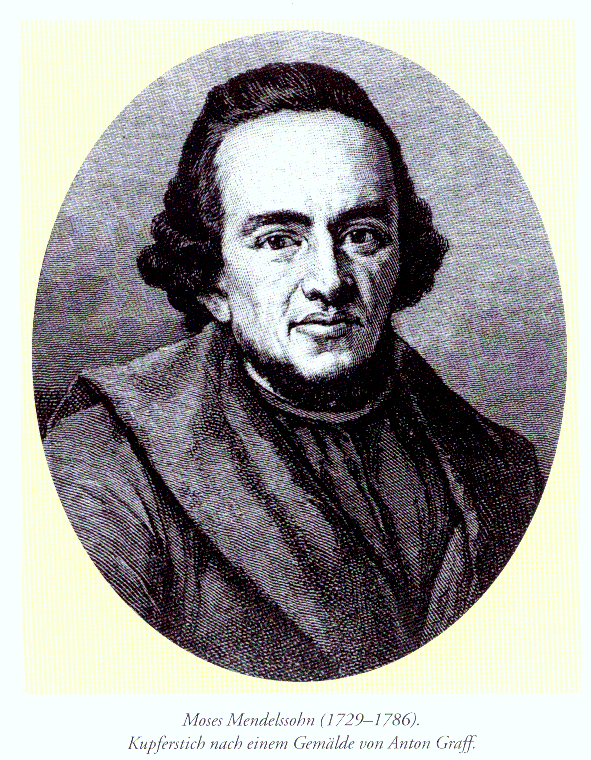

Moses Mendelssohn was born in Dessau in 1729 and followed his rabbi to Berlin at fourteen, where he studied with a scholar of Maimonides and later earned his living as a silk firm’s accountant. In 1754 he began a lifelong friendship with Gotthold Ephraim Lessing, with whom he edited literary journals, and in 1763 he won the Prussian Academy’s prize for his essay on evidence in metaphysics.
His metaphysics came from Leibniz, Wolff and Baumgarten, and his Phaedo, loosely modelled on Plato’s dialogue, was a bestseller whose argument for the soul’s immortality Kant singled out for criticism. Called “the Jewish Luther”, he campaigned for Jewish civil rights and translated the Pentateuch and Psalms into German. Johann Lavater publicly challenged him to refute a defence of Christianity or convert; he answered with a plea for tolerance. He died in 1786, shortly after defending Lessing against Jacobi’s charge of Spinozism, and is remembered as the model for Lessing’s tolerant hero Nathan the Wise.
Key ideas
- The soul is simple
- Memory, reflection and the unity of self-consciousness could not arise from anything made of parts. So there must be a single, unextended substance that holds all our ideas and desires together, and being simple it cannot perish.
- No coercion of conscience
- In Jerusalem he argued that neither the state nor religion can rightly force anyone’s convictions; both can only teach and persuade. Judaism itself, he claimed, supports this, and the right to excommunicate was a later borrowing.
- Merely verbal disputes
- Late in life he suspected that many quarrels between philosophical schools, including the debate between materialists, idealists and dualists, were at bottom disputes about words.
- Tradition
- Jewish
- Region
- Dessau and Berlin
Influences
Influenced by
Moses Mendelssohn1729–1786
Influenced
Influenced by
Moses Mendelssohn1729–1786
Influenced
Where these links come from
- Moses Mendelssohn drew on Plato. Source: Daniel Dahlstrom, Moses Mendelssohn, Stanford Encyclopedia of Philosophy
- Moses Mendelssohn drew on Maimonides. Source: Daniel Dahlstrom, Moses Mendelssohn, Stanford Encyclopedia of Philosophy
- Moses Mendelssohn drew on Gottfried Wilhelm Leibniz. Source: Daniel Dahlstrom, Moses Mendelssohn, Stanford Encyclopedia of Philosophy
- Immanuel Kant argued against Moses Mendelssohn. Source: Daniel Dahlstrom, Moses Mendelssohn, Stanford Encyclopedia of Philosophy
Key works
- Phaedo, or On the Immortality of the Soul (Phädon), 1767
- Jerusalem, or on Religious Power and Judaism (Jerusalem), 1783
- Morning Hours (Morgenstunden), 1785
Sources
- Daniel Dahlstrom, Moses Mendelssohn, Stanford Encyclopedia of Philosophy