Philosopher
Michael Dummett
1925–2011
English philosopher who interpreted Frege as the founder of analytic philosophy and argued for "anti-realism": that what our sentences mean depends on what we can recognise as evidence for them.
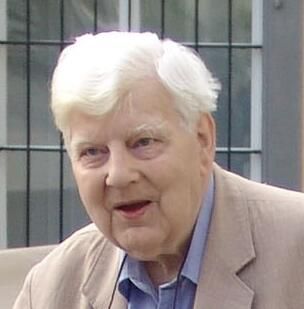

Michael Dummett was educated at Winchester, served in the armed forces from 1943 to 1947, and became a Roman Catholic in 1944. After a first in Philosophy, Politics and Economics at Christ Church, Oxford, he won a fellowship at All Souls in 1950. From 1965 he and his wife Ann devoted years to fighting racism, helping to found the Oxford Committee for Racial Integration and later the Joint Council for the Welfare of Immigrants. His first major book, Frege: Philosophy of Language, appeared only in 1973, and it transformed the study of Frege.
He was Wykeham Professor of Logic at Oxford from 1979 until he retired in 1992. Besides his work on Frege, intuitionist logic and the debate between realism and anti-realism, he wrote on voting procedures, on immigration, and, with Sylvia Mann, on the history of tarot card games.
Key ideas
- Philosophy of language first
- Frege’s great insight, on which analytic philosophy rests, is that thought should be studied through language. A theory of meaning is therefore the foundation for the rest of philosophy.
- Anti-realism
- To understand a sentence is to be able to recognise what would count as evidence for or against it. So there is no guarantee that every statement is determinately true or false, and the anti-realist rejects classical logic’s principle that it must be.
- Meaning is use
- From Wittgenstein he took the idea that knowing a word’s meaning is being able to use it correctly, and spent much of his career spelling out what that ability involves.
- Realism debate by debate
- Realism and anti-realism should be settled one subject matter at a time, so one might be an anti-realist about arithmetic yet a realist about the past.
- Tradition
- Western
- Region
- England
- Period
- Contemporary
- Themes
- Language and meaning
Influences
Influenced by
Michael Dummett1925–2011
Influenced
Influenced by
Michael Dummett1925–2011
Influenced
Where these links come from
- Michael Dummett drew on Gottlob Frege. Source: Benjamin Murphy, Michael Dummett, Internet Encyclopedia of Philosophy
- Michael Dummett drew on Ludwig Wittgenstein. Source: Benjamin Murphy, Michael Dummett, Internet Encyclopedia of Philosophy
- Jürgen Habermas drew on Michael Dummett. Source: James Gordon Finlayson and Dafydd Huw Rees, Jürgen Habermas, Stanford Encyclopedia of Philosophy
Key works
- Frege: Philosophy of Language, 1973
- Elements of Intuitionism, 1977
- Truth and Other Enigmas, 1978
- The Logical Basis of Metaphysics, 1991
Sources
- Benjamin Murphy, Michael Dummett, Internet Encyclopedia of Philosophy