Philosopher
Laozi
fl. 600–500 BCE
Also known as Lao-tzu, Lao Dan
Semi-legendary sage traditionally credited with the Daodejing, the founding text of Daoism, which counsels living in harmony with the dao through simplicity and non-action.
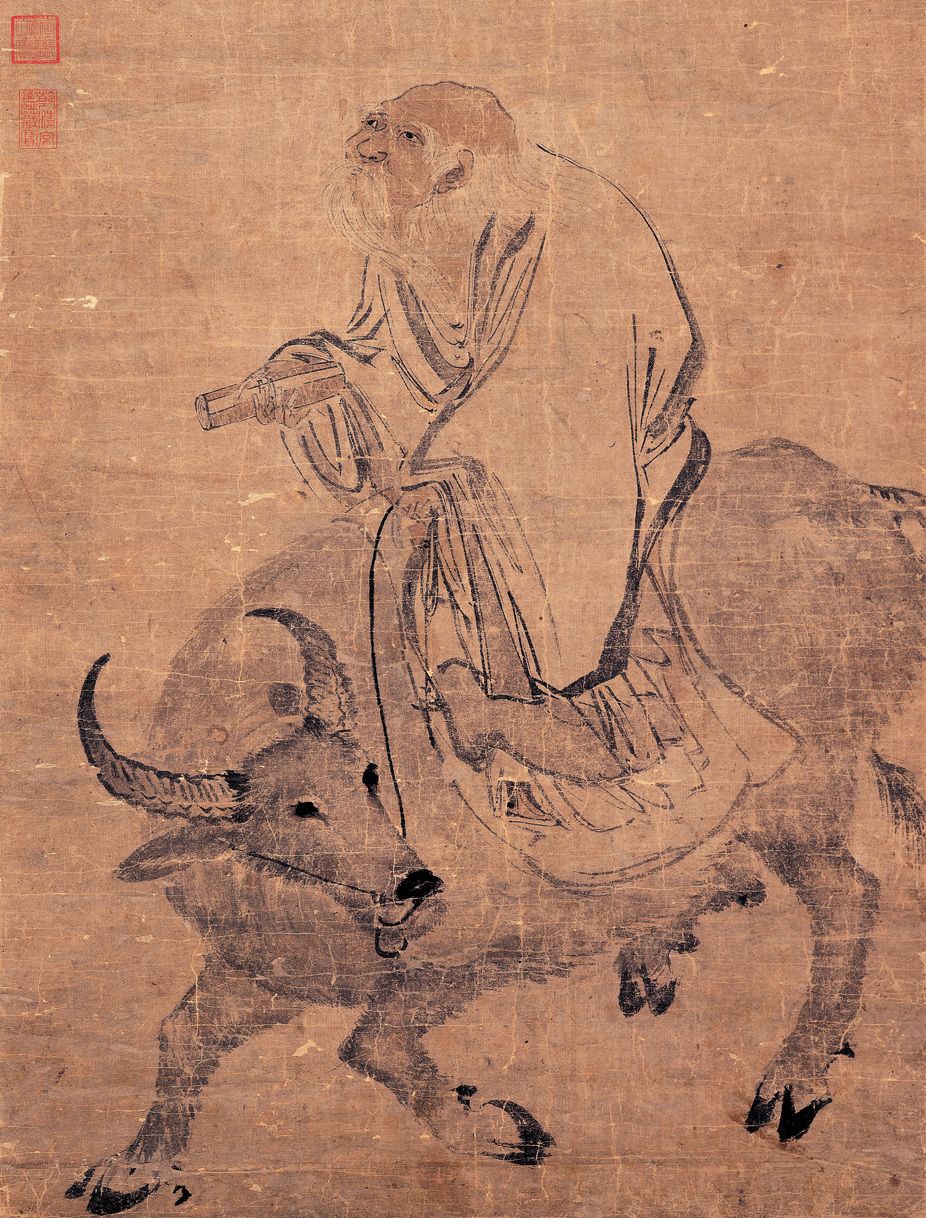
.jpg)
The Tao that can be trodden is not the enduring and unchanging Tao.
The journey of a thousand li commenced with a single step.
According to Chinese tradition, Laozi was an archivist at the Zhou court and an older contemporary of Confucius who, leaving China through a western pass, wrote down his teachings at the request of the gatekeeper. Many scholars doubt that he was a single historical person, and the Daodejing that bears his name is generally thought to have taken shape over time.
The Daodejing presents the dao, or “way”, as the nameless source of all things, and recommends wuwei (acting without forcing) together with simplicity and humility, for individuals and rulers alike. The dates given here are the traditional ones.
Key ideas
- The Dao (the Way)
- The constant Dao cannot be defined or described. It has no name, shape or form and lies beyond the senses, yet it is the inexhaustible source from which heaven and earth are born.
- Wu (nonbeing)
- Because Dao has no form or limits, it cannot be reduced to any particular thing or captured by names. It can only be described as wu, “not having” any of the characteristics of things.
- Ziran (naturalness)
- Literally “self so”. Dao is modelled on nothing but itself, and the ways of nature express it. People, born of heaven and earth, should live and act in accord with nature.
- Wuwei (nonaction)
- Not doing nothing, but acting without self-serving desire. The Laozi traces political disorder to excessive desire, and recommends simplicity and quietude instead.
- Tradition
- Chinese
- Schools
- Daoism
- Period
- Classical Chinese
Influences
Laozifl. 600–500 BCE
Influenced
Laozifl. 600–500 BCE
Influenced
Where these links come from
- Han Fei drew on Laozi. Source: Yuri Pines, Legalism in Chinese Philosophy, Stanford Encyclopedia of Philosophy
- Yang Xiong drew on Laozi. Source: Andrew Colvin, Yang Xiong, Internet Encyclopedia of Philosophy
- Wang Chong drew on and argued against Laozi. Source: Alexus McLeod, Wang Chong (Wang Ch’ung), Internet Encyclopedia of Philosophy
- Zhong Hui drew on Laozi. Source: Alan Kam-Leung Chan, Zhong Hui (Chung Hui), Internet Encyclopedia of Philosophy
- Wang Bi drew on Laozi. Source: Ronnie Littlejohn, Wang Bi (Wang Pi), Internet Encyclopedia of Philosophy
- Sengzhao drew on Laozi. Source: Jeffrey Dippmann, Sengzhao, Internet Encyclopedia of Philosophy
- Zongmi argued against Laozi. Source: Bryan Van Norden and Nicholaos Jones, Huayan Buddhism, Stanford Encyclopedia of Philosophy
Key works
- Daodejing (Laozi)
- Read free at Standard Ebooks (translated by James Legge)
Terms on this page
- wuwei
- Nonaction (無為): acting without contrivance, letting things take their natural course. In the Laozi it is how naturalness (ziran) is put into practice.
- wu
- Nonbeing or nothingness (無), literally “not having”. The Laozi says that being is born of nonbeing and speaks of the Dao itself as nonbeing; Wang Bi and He Yan held that nothingness is the root of all beings.
- ziran
- Naturalness, literally being “self so” (自然): how things are when they follow their own course. The Laozi uses it to describe the workings of the Dao, and Guo Xiang held that social roles too arise naturally.
Sources
- Alan Chan, Laozi, Stanford Encyclopedia of Philosophy