Philosopher
Alexander Crummell
1819–1898
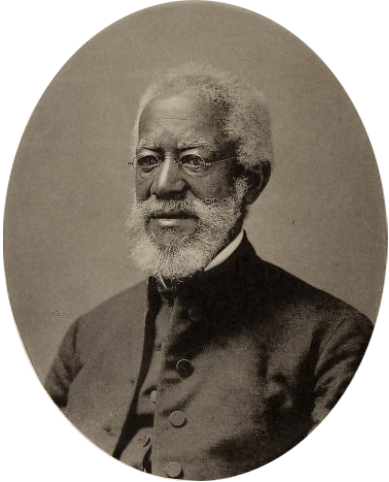
Black American priest and philosopher, the leading rationalist of the nineteenth-century Black enlightenment, who put reason at the centre of moral agency.
.png)
Alexander Crummell was born free in New York City in 1819. His mother was born free; his father, of the Temne people of West Africa, had been sold into slavery and gained his freedom as an adult. Crummell became a prominent young voice in the anti-slavery movement, trained for the Episcopal priesthood despite racist resistance, studied theology at Yale and moral philosophy at Cambridge under William Whewell, whose intuitionism shaped his own views, and took his degree at Queens’ College.
He then taught English and moral philosophy at Liberia College, returning to the United States after the Civil War. His protégé W. E. B. Du Bois helped keep his influence alive, but he fell from favour as more relativist thinkers such as Alain Locke came to the fore. He died in 1898.
Key ideas
- The primacy of moral reason
- The mind is made of instinct, passion and reason, and reason comes first: a native, spontaneous recognition of moral truth. Education and religious training exist to let people see those eternal principles intuitively.
- The problem of moral change
- No people, Crummell argued, has raised itself to moral enlightenment unaided, yet enlightenment brought purely from outside cannot take root. So some must first be enlightened from within a community for the rest to follow.
- Reason, language and history
- He worked out what the priority of reason implied for language and for history, giving his philosophy a breadth unmatched by other thinkers of the Black enlightenment.
- Tradition
- African
- Region
- New York, Cambridge and Liberia
- Themes
- Human nature
Influences
Where these links come from
- W. E. B. Du Bois drew on Alexander Crummell. Source: Stephen Thompson, Alexander Crummell, Stanford Encyclopedia of Philosophy
Key works
- The Future of Africa, 1862
Sources
- Stephen Thompson, Alexander Crummell, Stanford Encyclopedia of Philosophy