Philosopher
Rumi
1207–1273
Also known as Rūmī, Jalal al-Din Rumi, Jalāl al-Dīn Balkhī
Persian Sufi poet of the Mathnawi who mocked philosophers' 'wooden legs', yet shaped post-Avicennian philosophical Sufism with his critique of reason's reach.
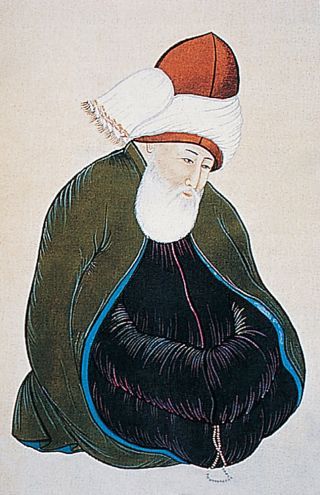

Jalal al-Din Balkhi, known as Rumi, is regarded by many as one of the greatest Sufi poets of Islam. His Mathnawi has been called ‘the Persian Qur’an’. In it he scorns discursive thought, comparing rationalists’ legs to stilts.
Even so, his critique of Peripatetic philosophy is closer to al-Ghazali’s critique of rationalism than to an outright rejection, and he became an influential figure in the philosophical Sufism that followed Avicenna. He also warned against blindly following authority, aiming especially at jurists who held a divine command theory.
Key ideas
- Epistemological humility
- Rumi criticised the usual routes to truth, by correspondence, by authority and by reasoning, while leaving room for truth known through experience.
- The limits of the senses
- The senses give us some knowledge, but not the kind that can reveal spiritual and existential truth.
- Universal and particular intellect
- Rumi distinguished a universal intellect, concerned with the divine realm, from a particular intellect whose reach is limited to this world, and held, against the Mu’tazilites, that intellects differ by nature.
- Tradition
- Arabic and Islamic
- Region
- Balkh
- Period
- Later Islamic
- Themes
- Knowledge and scepticism
Key works
- Mathnawi
- Read free at Project Gutenberg (translated by James W. Redhouse, book 1 of 6)
Sources
- Mehdi Aminrazavi, Mysticism in Arabic and Islamic Philosophy, Stanford Encyclopedia of Philosophy