Philosopher
Margaret Cavendish
1623–1673
Also known as Margaret Lucas Cavendish, Margaret Lucas
Seventeenth-century philosopher, scientist and writer whose naturalism held that matter itself thinks: minds are material, and perception and reason run through the whole of nature.
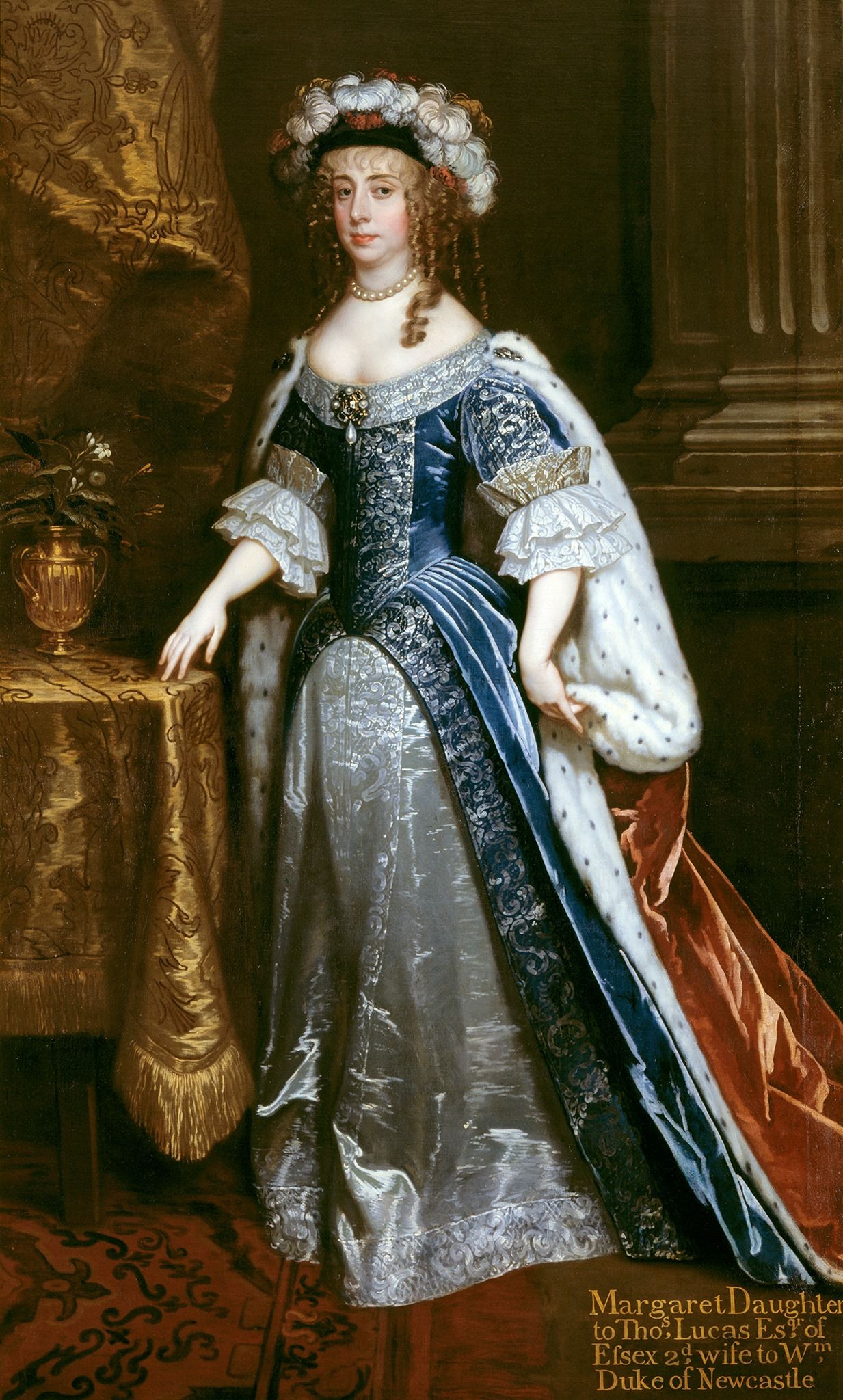

Margaret Lucas was born in Colchester in 1623. She had no formal education in mathematics, philosophy or the classical languages, but read widely in scholarly libraries and talked philosophy with her brother John, later one of the Royal Society’s founders. In 1643 she became a maid of honour to Queen Henrietta Maria, followed her into exile in France, and in 1645 married William Cavendish; they lived in Paris, Rotterdam and Antwerp until the Restoration in 1660. His “Cavendish Circle” brought together Hobbes, Descartes, Mersenne and Gassendi.
Few publishers would print a woman’s philosophy, and her husband’s connections helped her publish. She wrote philosophy, science, poetry, plays and fiction, and much of her social and political thought is in imaginative works such as The Blazing World. In 1667 she was invited to attend the Royal Society, a rare honour, though many there treated her as a spectacle. She died in 1673 and was buried in Westminster Abbey.
Key ideas
- Minds are material
- If our thinking takes place in our heads, our thoughts must have shape and a location, and place belongs only to bodies. And since there is no immaterial motion, a mind that moves along with its body must itself be material.
- Thought throughout nature
- Thinking is not confined to human brains. Crocodiles and birds foresee floods and storms, ants plan their cities, and mentality runs through all of nature, down to insects and cells.
- Thinking is basic to bodies
- Hobbes treated thought and sensation as motions in the brain. Cavendish took thinking and intelligence to be fundamental to bodies, needing no further explanation, and bodies that interact communicate and coordinate their behaviour.
- Freedom and imagined worlds
- To be free is to be able to do as one pleases without obstacles. Where the actual world blocks the life one identifies with, imagining other worlds lets one live a version of it, as Cavendish did in The Blazing World.
- Tradition
- Western
- Region
- England, and in exile in Paris, Rotterdam and Antwerp
- Period
- Early modern
Influences
Influenced by
Margaret Cavendish1623–1673
Influenced by
Margaret Cavendish1623–1673
Where these links come from
- Margaret Cavendish argued against Thomas Hobbes. Source: David Cunning, Margaret Lucas Cavendish, Stanford Encyclopedia of Philosophy
- Margaret Cavendish argued against René Descartes. Source: David Cunning, Margaret Lucas Cavendish, Stanford Encyclopedia of Philosophy
Key works
- Philosophical and Physical Opinions, 1656
- Philosophical Letters, 1664
- Observations upon Experimental Philosophy, 1666
- The Description of a New World, Called the Blazing World, 1666
- Grounds of Natural Philosophy, 1668
Sources
- David Cunning, Margaret Lucas Cavendish, Stanford Encyclopedia of Philosophy