Philosopher
Madame de Sablé
1598–1678
Also known as Madeleine de Souvré, Marquise de Sablé
Paris salon host and patron of La Rochefoucauld whose maxims unmasked virtue as disguised pride and self-interest, with friendship as the one exception.
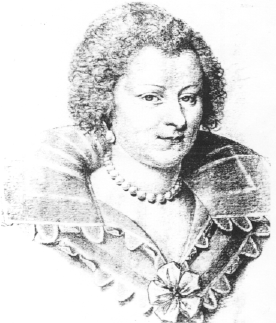

Madeleine de Souvré was born in 1598 into an old aristocratic family; her father was a marshal of France and governor of the young Louis XIII, and she served Queen Marie de Médicis as a lady-in-waiting. She attended Madeleine de Scudéry’s salon and then held her own, first in the Place Royale and from 1655 in rooms built at the convent of Port-Royal.
Known to history as La Rochefoucauld’s patron and as a correspondent of Blaise Pascal and Antoine Arnauld, she defended Jansenism in civil and church circles. She died in 1678.
Key ideas
- Virtue as a mask
- In her maxims, virtue is usually a mask for vice, most often pride, and self-interest is the usual motive behind apparently selfless acts; the critique exposes self-promotion in the hierarchy of the court.
- Friendship as the exception
- In intimate friendship, with sacrifice on both sides, genuine virtue can flourish: the single exception to society’s masquerade of disguised self-interest.
- Morality in the light of faith
- She denied that natural moral virtue could be relied on and held, as a Jansenist, that true moral order can be grasped only in the light of faith.
- Tradition
- Western
- Region
- Paris
- Branches
- Ethics
- Period
- Early modern
- Themes
- Love and friendship
Key works
- Maxims (Maximes)
- Read free at Wikisource (in French)
Sources
- John J. Conley, Madeleine de Sablé, Internet Encyclopedia of Philosophy