Philosopher
Lucrezia Marinella
c. 1571 – 1653
Also known as Lucrezia Marinelli
Venetian author whose The Nobility and Excellence of Women argued that women's souls and bodies make them superior to men in reason and virtue, and demanded freedom and equality.
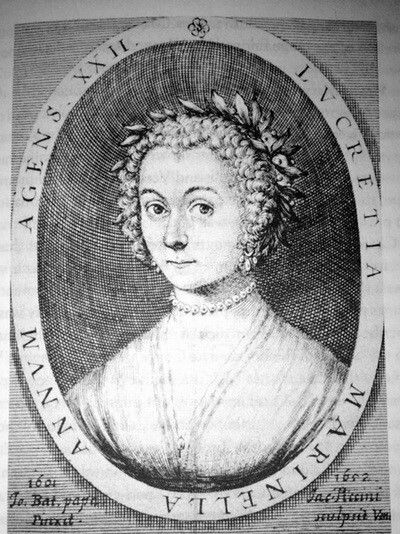
.jpg)
Lucrezia Marinella spent her whole life in Venice, where she was born in about 1571, or perhaps 1579, and died in 1653. Her father, a physician who wrote medical treatises, two of them on women, encouraged her studies and gave her access to works of medicine, natural and moral philosophy and literature. She wrote in many genres, chiefly devotional prose and verse, and her polemics show training in rhetoric and dialectic that was rare among women of her time.
Her treatise on women’s nobility, published in 1600 and enlarged in 1601, was among the earliest Italian contributions by a woman to the querelle des femmes, the long argument over what women are and what they are worth. She married another physician late in life, which may have given her more freedom to study.
Key ideas
- Equality and superiority reconciled
- Earlier defenders of women argued both that the sexes are equal, sharing a rational soul, and that women are superior, without resolving the tension. Marinella faced it directly, arguing that women and men have different natures.
- Better souls, better bodies
- Women’s souls are better from their origin, and women’s bodies are better suited to support the soul’s work, so women excel in reason and in moral character.
- Freedom, not sympathy
- Marinella went beyond asking men for sympathy and respect to demand freedom, power and equality for women, analysing their situation in explicitly political terms.
- The motives of misogyny
- She was one of the first to explain why men wrote against women, and to connect those motives with women’s exclusion from public life.
- Tradition
- Western
- Region
- Venice
- Period
- Early modern
- Themes
- Women and gender
Key works
- The Nobility and Excellence of Women and the Defects and Vices of Men (La nobiltà et l'eccellenza delle donne, co' difetti et mancamenti de gli uomini), 1600
- Read free at Wikisource (in Italian, 1621 edition)
Sources
- Marguerite Deslauriers, Lucrezia Marinella, Stanford Encyclopedia of Philosophy