Philosopher
Jinul
1158–1210
Also known as Chinul, Pojo
Goryeo monk, counted as founder of the Jogye Order, who shaped Korean Seon (Zen) with sudden awakening followed by gradual cultivation, and with keyword meditation.
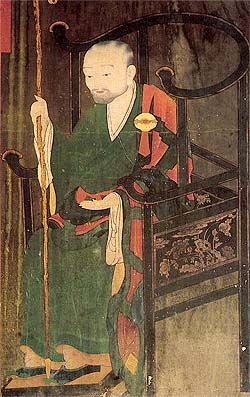

Jinul, whose Dharma name was Pojo, was a monk of the Goryeo dynasty, and is honoured as founder of the Jogye Order, the most significant Buddhist order in Korea today. Korean Seon, the Korean form of Chan, is often said to have reached maturity in his teachings, above all in his Secrets on Cultivating the Mind.
Seon taught that every being has Buddha-nature, which raised the question of why ordinary people cannot see it; Jinul’s answer was that it lies too close to us to be seen. Taking a middle course in the old Chan debate between sudden and gradual enlightenment, he joined meditation with the study of Hwaeom doctrine, and introduced keyword meditation, which became the main practice of Korean Seon. In the next dynasty the Neo-Confucian Jeong Dojeon singled out his ideas for attack as “nebulous supposition”.
Key ideas
- Void and calm, numinous awareness
- Ordinary people fail to see their Buddha-nature for the reason they cannot see their own bodies: they are inside it. It is known through “the mind of void and calm, numinous awareness”: insubstantial, reflecting all things like a still lake, yet aware of itself and responsive to an interconnected world.
- Sudden awakening, gradual cultivation
- Following Zongmi, Jinul held that sudden awakening must be followed by gradual cultivation, to keep old habits from returning. Once deluded thoughts are seen to be empty there is nothing to remove, so true cultivation is “cultivation without cultivating anything”.
- Concentration and wisdom together
- Concentration (samādhi) and wisdom (prajñā) are not two paths but essence and function of one practice: without concentration insight is unsteady, and without wisdom concentration cannot uproot defilements. Linking them to Seon meditation and to Hwaeom doctrine, Jinul joined the two.
- Keyword meditation (hwadu)
- Even profound doctrine is bound by language, which splits subject from object. Jinul championed Kanhwa Seon, meditation on a critical phrase from a Chan dialogue, as the shortcut that frees practitioners from a merely conceptual grasp of the truth.
- Tradition
- Korean
- Region
- Goryeo, Korea
- Schools
- Chan Buddhism
- Period
- Goryeo
Influences
Where these links come from
- Jinul drew on Li Tongxuan. Source: Bryan Van Norden and Nicholaos Jones, Huayan Buddhism, Stanford Encyclopedia of Philosophy
- Jeong Dojeon argued against Jinul. Source: Kevin N. Cawley, Korean Confucianism, Stanford Encyclopedia of Philosophy
Key works
- Secrets on Cultivating the Mind (Susimgyŏl)
- Read free at Wikisource (in Classical Chinese)
- Treatise on Resolving Doubts about Observing the Keyword (Kanhwa kyŏrŭiron)
Terms on this page
- samādhi
- Concentration, the meditative stability of the mind. Jinul held that it and wisdom (prajñā) are essence and function of a single practice.
- prajñā
- Wisdom, the insight that sees things as they truly are. Jinul paired it with concentration (samādhi) as two sides of one practice; for Sengzhao it knows without concepts or a split between subject and object.
- hwadu
- The keyword (話頭; Chinese huatou): a critical phrase taken from a Chan dialogue and made the focus of meditation in Kanhwa Seon, which Jinul championed.
Sources
- Bryan Van Norden and Nicholaos Jones, Huayan Buddhism, Stanford Encyclopedia of Philosophy
- Lucy Hyekyung Jee, Korean Buddhism, Stanford Encyclopedia of Philosophy
- Halla Kim, Korean Philosophy, Stanford Encyclopedia of Philosophy