Philosopher
Huang Zongxi
1610–1695
Ming-Qing polymath and historian of Ming thought who turned the learning of the mind outward, to effort, history and the practical ordering of the world.
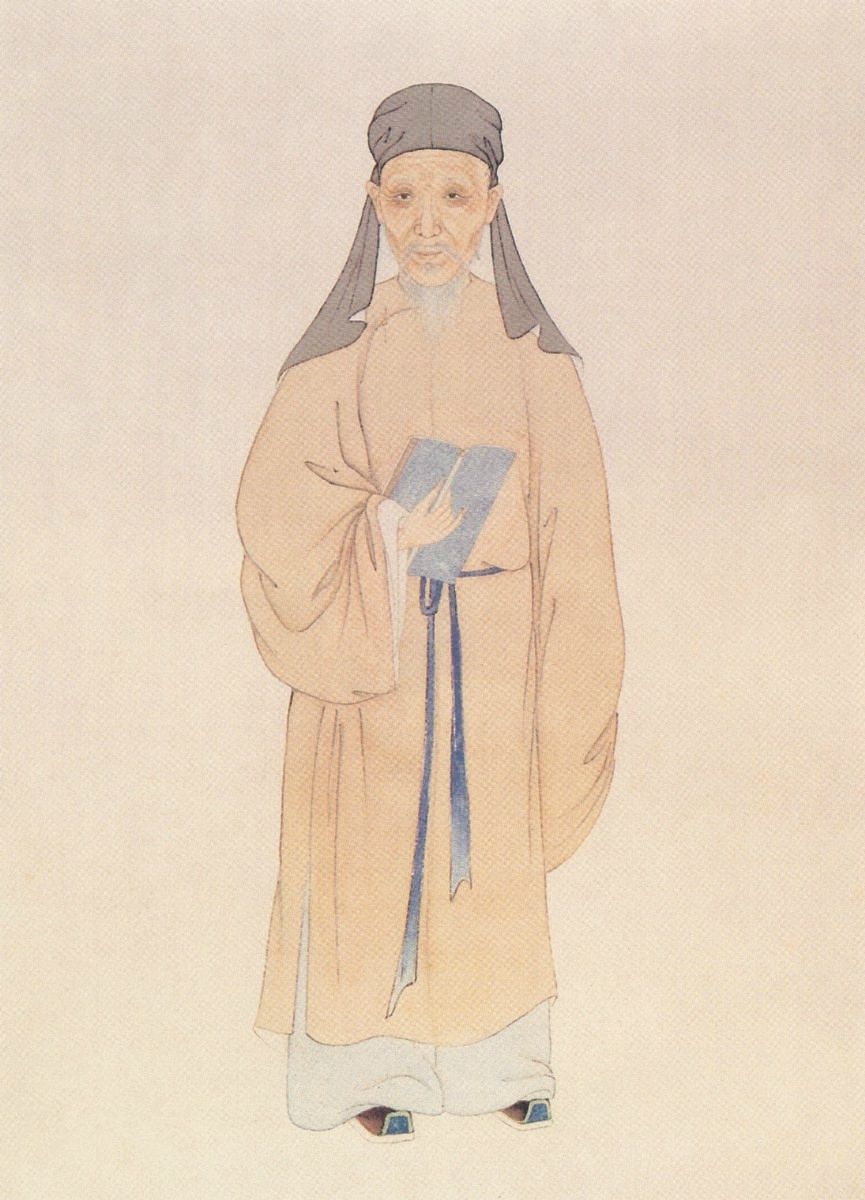

Huang Zongxi was a polymath and contemporary of Gu Yanwu and Wang Fuzhi. A self-declared follower of the Lu–Wang tradition, he reinterpreted Wang Yangming’s central idea of ‘extending moral knowing’ in intellectual terms.
His masterpiece, Intellectual Records of Ming Scholars, opens with a statement of his historicist outlook. He saw the inseparability of principle and qi as a basic fact of reality: principle is the principle of qi.
Key ideas
- The mind has no fixed substance
- Heaven and earth are filled with the mind-heart, which changes unpredictably. It has no fundamental substance: substance is what its effort achieves, so to investigate principle is to probe the mind’s many forms.
- An outward turn
- Though he began from the mind, Huang moved away from the inward focus of the learning of the mind, towards effort and the ever-changing physical world.
- Learning for ordering the world
- Bringing peace to the country and preserving society are the duties of the noble person. Huang mocked scholars who despised finance and administration, and found the practical ways of the world in the classics and histories.
- Tradition
- Chinese
- Region
- China
- Schools
- Confucianism
- Themes
- How to govern
Influences
Where these links come from
- Huang Zongxi drew on Wang Yangming. Source: On-cho Ng, Qing Philosophy, Stanford Encyclopedia of Philosophy
Key works
- Intellectual Records of Ming Scholars (Mingru xue'an)
- Read free at Wikisource (in Classical Chinese)
Terms on this page
- qi
- Vital force or material force (氣), the stuff of which all things are made. Neo-Confucians paired it with principle (li), and explained the differences between people by the qi each is endowed with.
Sources
- On-cho Ng, Qing Philosophy, Stanford Encyclopedia of Philosophy