Philosopher
Feng Youlan
1895–1990
Also known as Fung Yu-lan, Zhisheng
Historian of Chinese philosophy who rebuilt Zhu Xi's learning of principle with the tools of Western logic, and later reworked his thought under Mao in Marxist terms.
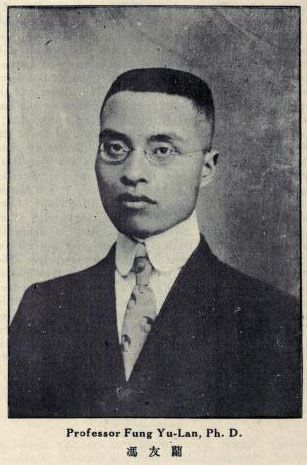

Feng Youlan grew up in Henan with a traditional Confucian education, studied philosophy at Peking University and then, like Hu Shi before him, went to Columbia University to study with John Dewey, completing his doctorate in 1923. Back in China he became chair of philosophy and dean of humanities at Tsinghua University. His History of Chinese Philosophy (1934), later translated into English by Derk Bodde, remains his most lasting achievement, and is still read, though critics have found it partial to Confucianism over Buddhism and Daoism.
During the war with Japan he published the six books in which he set out his own system, a “New Philosophy of Principle” built on Cheng Yi and Zhu Xi. After the Communist revolution he told Mao Zedong that he was “unwilling to be a remnant of a bygone age in a time of greatness”, and reinterpreted his earlier work and Chinese philosophy in Marxist terms, while trying to keep an abstract place for Confucian ideas such as ren. Denounced during the Cultural Revolution, he later joined Jiang Qing’s campaign against Confucius, which cost him his reputation for a time. He was working on a new, Marxist history of Chinese philosophy when he died.
Key ideas
- Subtraction, augmentation and the middle way
- Philosophies either subtract, returning to nature by reducing human artifice, as Laozi and Zhuangzi taught; or augment, conquering and transforming nature, as Mozi and the West did. Confucianism is the middle way, cultivating a balance between humans and nature.
- A new learning of principle
- Feng distinguished the “True Realm” of principle (li), universal, abstract and eternal, from the “Real Realm” of material force (qi) and concrete things. The True Realm comes first, not in time but in being, and each kind of thing is an imperfect expression of its principle.
- Moral truths are real
- His philosophy was realist. Moral truths are facts, existing abstractly as principle and showing themselves in the flowing world of material things, so ethics and the study of being belong together.
- The Great Whole
- Adapting the Buddhist idea of the “emptiness of emptiness”, Feng spoke of the Great Whole, the totality of all that exists, in which all things are one. Human beings define themselves, and find their purpose, through their understanding of the universe.
- Chinese thought is philosophy
- His History of Chinese Philosophy treated Chinese and Western thought within the one category of philosophy, at a time when the Chinese word for it was usually kept for Western thought. He read the tradition critically, but as a valuable legacy, not as pious fabrication.
- Tradition
- Chinese
- Region
- Beijing, China
- Schools
- Confucianism
- Themes
- What is ultimately real
Influences
Where these links come from
- Feng Youlan drew on Cheng Yi. Source: Xiaofei Tu, Feng Youlan (Fung Yu-lan), Internet Encyclopedia of Philosophy
- Feng Youlan drew on Zhu Xi. Source: Xiaofei Tu, Feng Youlan (Fung Yu-lan), Internet Encyclopedia of Philosophy
- Feng Youlan studied with John Dewey. Source: Xiaofei Tu, Feng Youlan (Fung Yu-lan), Internet Encyclopedia of Philosophy
Key works
- A History of Chinese Philosophy (Zhongguo zhexue shi), 1934
- A New Philosophy of Principle (Xin lixue)
- A Short History of Chinese Philosophy, 1948
Terms on this page
- ren
- Humaneness or benevolence (仁), the cardinal Confucian virtue. Cheng Hao treated it as the whole of human nature, by which a person forms one body with all things and feels their pain as their own.
- li
- Pattern or principle (理), the central concept of Neo-Confucianism, identified with human nature. With the Cheng brothers it became, for the first time, the ultimate reality of all that exists.
- qi
- Vital force or material force (氣), the stuff of which all things are made. Neo-Confucians paired it with principle (li), and explained the differences between people by the qi each is endowed with.
Sources
- Xiaofei Tu, Feng Youlan (Fung Yu-lan), Internet Encyclopedia of Philosophy