Philosopher
Fazang
643–712 CE
Also known as Fa-tsang
Systematiser of Flower Garland (Huayan) Buddhism, who taught that all things contain and reflect one another, and served the empress Wu Zhao as lecturer, translator and ideologue.
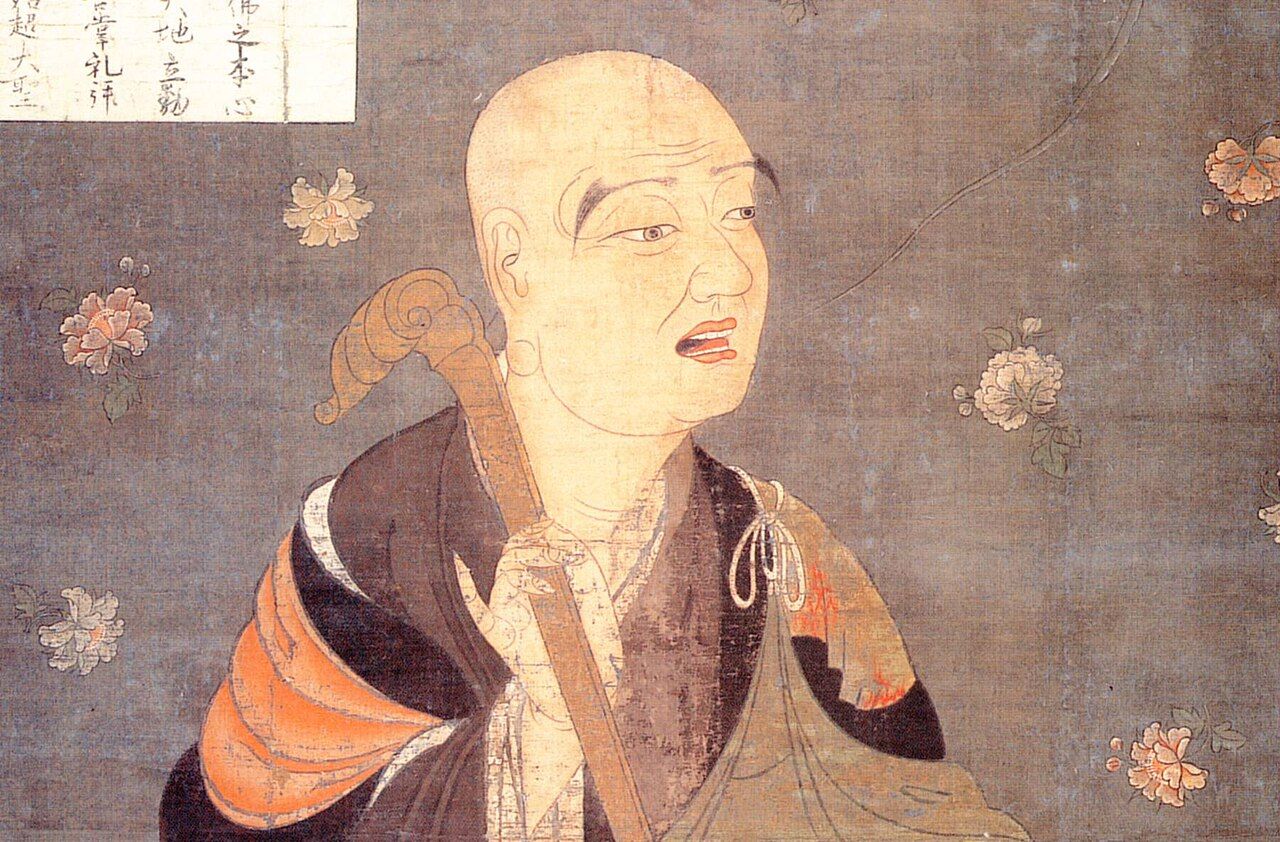

Fazang came from a Sogdian family, of the Iranian civilisation of Central Asia, and as a young man embraced Buddhism with fervent devotion. He became the student of Zhiyan, a master of the Flower Garland Sutra, and spent the rest of his life expounding it, lecturing on it more than thirty times to monks and rulers and helping to produce a new, longer translation. He is counted as the third patriarch and the systematiser of the Flower Garland (Huayan) school.
He worked for four decades close to imperial power, above all for Wu Zhao, the only woman to rule China as emperor. His picture of a perfectly ordered universe, in which a single centre is reflected everywhere, lent itself to her claim to be a universal Buddhist monarch, and he wrote commentaries that exalted her rule. In 705 he nonetheless supported the coup that removed her, and went on to serve the emperors who followed. Later biographies credit him with miracles, including bringing rain in times of drought.
Key ideas
- Universal interpenetration
- Emptiness (śūnyatā) means that everything is interconnected. Each element pervades all that exists and contains all the others, so the infinite shows itself in the smallest thing and apparent opposites coexist without obstruction.
- Indra’s net
- In the net of the god Indra each jewel reflects the images of all the others, and the reflections multiply without end. No object can be understood on its own; what it is depends on its place among everything else. Fazang built a hall of mirrors around a statue of the Buddha to show it.
- The golden lion
- A lion made of gold stands for the cosmos. Mane, teeth, claws and eyes seem separate, yet all are the same gold, which stands for emptiness, and in each hair there are infinite lions. Their differences are only on the surface.
- Five levels of teaching
- Fazang ranked the Buddha’s teachings in five grades, from the Hīnayāna up to the “comprehensive teaching of the One Vehicle” of the Flower Garland Sutra. Other schools were included, not rejected, but placed beneath the Flower Garland teaching.
- Enlightenment from the first step
- Since each part contains the whole, “when one is perfected, all are perfected”, and whoever first resolves to seek enlightenment for the sake of all beings is already perfectly enlightened.
- Tradition
- Chinese
- Region
- Chang'an and Luoyang, Tang China
- Themes
- What is ultimately real
Influences
Where these links come from
- Fazang studied with Zhiyan. Source: Bryan Van Norden and Nicholaos Jones, Huayan Buddhism, Stanford Encyclopedia of Philosophy
- Fazang drew on Wonhyo. Source: Lucy Hyekyung Jee, Korean Buddhism, Stanford Encyclopedia of Philosophy
Key works
- Essay on the Golden Lion (Jin shizi zhang)
- Treatise on the Five Teachings (Huayan wujiao zhang)
- Read free at Wikisource (in Classical Chinese)
Terms on this page
- śūnyatā
- Emptiness: the central notion of Nāgārjuna’s Madhyamaka, that all things are empty of intrinsic nature (svabhāva), since nothing exists independently of other things.
Sources
- Bryan Van Norden and Nicholaos Jones, Huayan Buddhism, Stanford Encyclopedia of Philosophy
- Norman Harry Rothschild, Fazang (Fa-tsang), Internet Encyclopedia of Philosophy
- Lucy Hyekyung Jee, Korean Buddhism, Stanford Encyclopedia of Philosophy