Philosopher
Émilie du Châtelet
1706–1749
Also known as Emilie du Chatelet, Gabrielle Émilie le Tonnelier de Breteuil, Marquise du Châtelet
French natural philosopher who gave Newton's physics a Leibnizian metaphysical foundation, defended the use of hypotheses in science, and made the standard French translation of Newton's Principia.
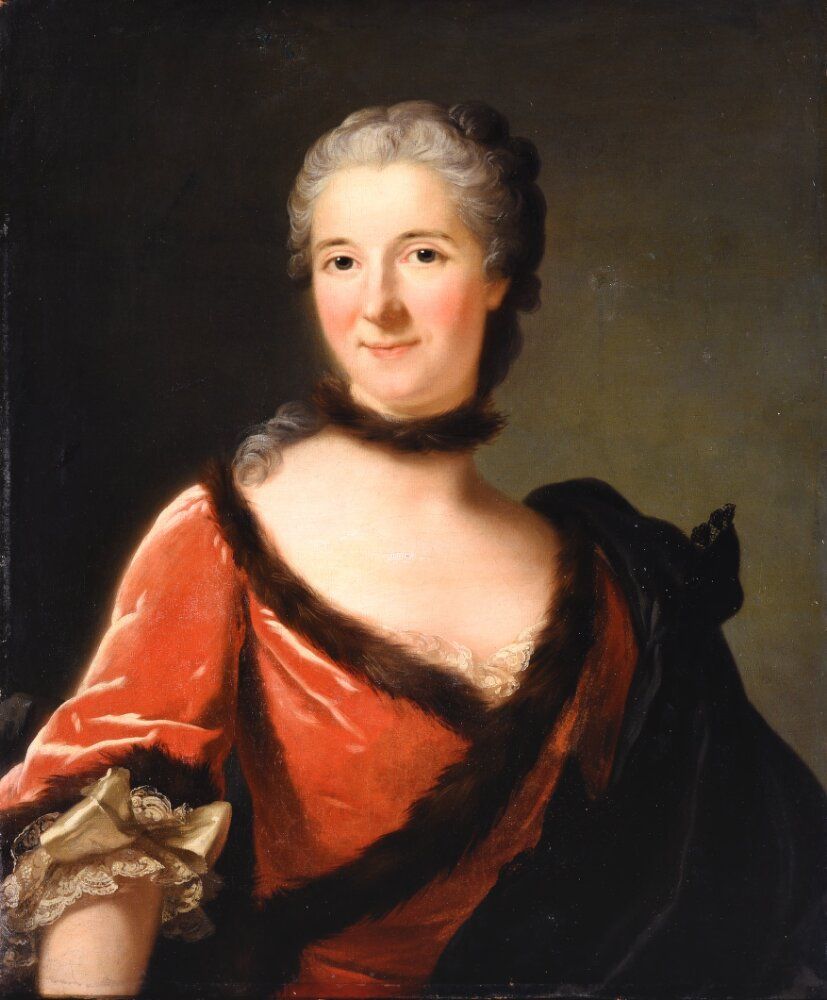
,_Marquise_du_Ch%C3%A2telet_-_NMDrh_796_-_Nationalmuseum.jpg)
Émilie le Tonnelier de Breteuil was born in Paris in 1706 and married the Marquis du Châtelet-Lomont in 1725. In 1733 she met Voltaire, who became both her lover and her intellectual companion for life, and they set up a laboratory at her husband’s estate at Cirey. She sought tutoring from leading mathematicians, among them Maupertuis, Clairaut and Samuel Koenig, and her mathematical skill went beyond Voltaire’s; he acknowledged her contribution to his Elements of Newton’s Philosophy of 1738. In 1737 she entered a prize competition on the nature of fire, carrying out her experiments secretly, and her essay was published alongside the winners’.
Her Foundations of Physics (1740), ostensibly a textbook for her son, was a highly original work of natural philosophy. Koenig accused her of plagiarising his ideas, a charge that long overshadowed her reputation, though the Leibnizian ideas were already in her draft before he arrived. She died in 1749, days after giving birth, having just finished her translation of Newton’s Principia with commentary; published in 1759, it remains the standard French version.
Key ideas
- Two first principles
- All knowledge rests on two principles, the principle of contradiction and the principle of sufficient reason, which says that nothing is without a reason why it is so and not otherwise. Some truths of metaphysics can be demonstrated as rigorously as those of geometry.
- Takes up Gottfried Wilhelm Leibniz’s principle of sufficient reason
- Metaphysics beneath physics
- Newton’s physics describes the world mathematically but needs a foundation. Du Châtelet supplied one modelled on Leibniz and Wolff, beginning with God, the sufficient reason for a world of contingent things, who chose this world for its interconnection and order.
- Simple beings, not atoms
- Atoms are defined as extended yet indivisible, but whatever is extended can be divided, so atoms are impossible. The ultimate constituents of bodies must be unextended simple beings, which must exist if the composite, extended things we experience exist.
- Takes up Gottfried Wilhelm Leibniz’s Monads
- In defence of hypotheses
- Against the fashion of the Royal Society and the Académie, and of Voltaire, du Châtelet held that good hypotheses are the work of the greatest scientists, Copernicus, Kepler, Descartes and Newton among them, and that banning them would harm science.
- Attraction within limits
- Newton’s attraction explains gravity better than Descartes’ vortices, and also the tides and the motions of the moon. But some of Newton’s followers stretched it too far, making it explain cohesion, elasticity and electricity, as though attraction were a property of matter itself.
- Tradition
- Western
- Region
- Paris and Cirey
- Period
- Early modern
Influences
Influenced by
Émilie du Châtelet1706–1749
Influenced by
Émilie du Châtelet1706–1749
Where these links come from
- Émilie du Châtelet drew on and argued against René Descartes. Source: Karen Detlefsen, Émilie du Châtelet, Stanford Encyclopedia of Philosophy
- Émilie du Châtelet drew on Gottfried Wilhelm Leibniz. Source: Karen Detlefsen, Émilie du Châtelet, Stanford Encyclopedia of Philosophy
Key works
- Foundations of Physics (Institutions de physique), 1740
- Read free at Wikisource (in French)
- Dissertation on the Nature and Propagation of Fire
- Read free at Project Gutenberg (in French)
- Discourse on Happiness (Discours sur le bonheur)
- Translation of and commentary on Newton's Principia, 1759
Sources
- Karen Detlefsen, Émilie du Châtelet, Stanford Encyclopedia of Philosophy