Philosopher
Edith Stein
1891–1942
Also known as Teresa Benedicta of the Cross, Saint Teresa Benedicta of the Cross
Phenomenologist and Husserl's assistant, known for her account of empathy, who after converting to Catholicism joined phenomenology to Thomist metaphysics; she died at Auschwitz.
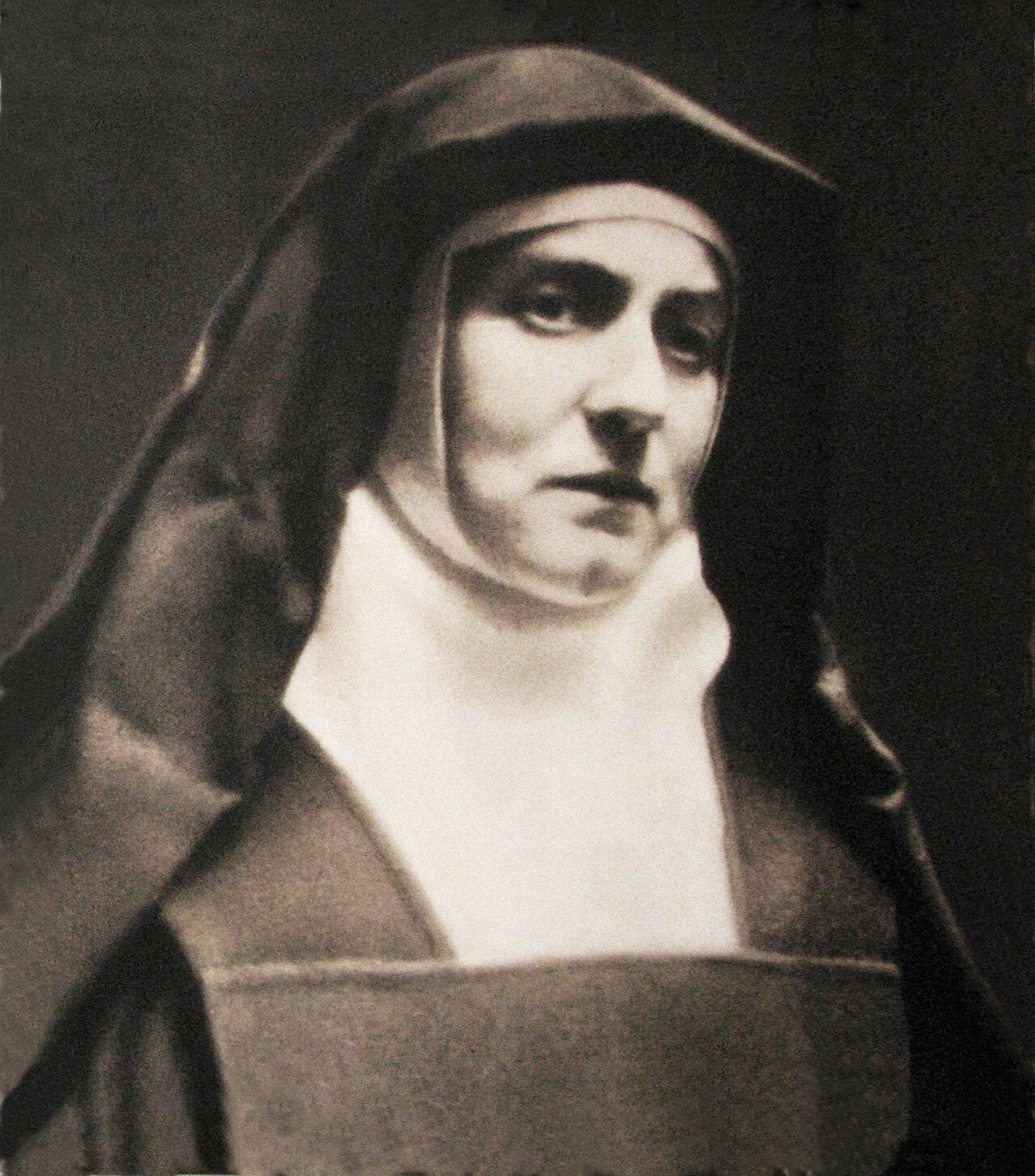
.jpg)
Edith Stein was born in 1891 into a Jewish family in Breslau and went to Göttingen in 1913, drawn by Husserl’s phenomenology. Her dissertation on empathy (1917) earned her a doctorate summa cum laude, and she became Husserl’s first paid assistant, editing manuscripts that later appeared as Ideas II and his lectures on time-consciousness, until she resigned in frustration in 1918. Universities would not let a woman take the Habilitation needed to teach, and her attempts came to nothing.
In 1921, reading the autobiography of Teresa of Ávila, she felt she had found the truth, and she became a Catholic the next year, translating Aquinas and teaching at a Dominican school. Dismissed from her post in Münster in 1933 because of her Jewish descent, she entered the Carmelite convent at Cologne, taking the name Teresa Benedicta of the Cross, and was moved for safety to Echt in the Netherlands in 1938. After the Dutch bishops condemned Nazi antisemitism in 1942, she and her sister Rosa were arrested and deported to Auschwitz, where they died on 9 August. She was canonised in 1998.
Key ideas
- Empathy
- Empathy is the basic way we meet other embodied subjects with experiences of their own, a kind of experience of its own, not built from perception or inference. I live through my empathising first-hand, but what it presents is another’s experience, so it always keeps the difference between self and other.
- Empathy is not fellow feeling
- Stein distinguished empathy from feeling with someone in their grief, from sympathy and compassion, from imitation and emotional contagion, and from feeling at one with another. Empathy also comes in layers, from a basic, perception-like form to complex understanding of another person.
- Psychic causality
- The mind is neither reducible to physical nature nor cut off from it. “Life-feelings” such as weariness or freshness colour the whole stream of experience, a causality of its own kind, whose laws are vague and allow only defeasible predictions, so they settle nothing about determinism.
- Finite and eternal being
- After her conversion Stein joined Husserl’s phenomenology to the metaphysics of Aquinas, beginning from realism about being, not from the meditating subject. Her eternal being was a Christian answer to Heidegger’s being as finitude, and with Duns Scotus she held that each individual has an essence of its own.
- Women’s nature and calling
- Stein defended women’s right to enter every profession and every branch of education, rejecting the idea of a “weaker sex”. Yet she held that women differ from men in soul as well as body, and criticised suffragists who, for the sake of equality, denied that women have a distinctive nature.
- Tradition
- Western
- Region
- Germany
- Schools
- Phenomenology
- Period
- Contemporary
Influences
Influenced by
- Thomas Aquinasc. 1225 – 1274
- John Duns Scotusc. 1265 – 1308
- Edmund Husserl1859–1938teacher
- Martin Heidegger1889–1976criticised
Edith Stein1891–1942
Influenced by
- Thomas Aquinasc. 1225 – 1274
- John Duns Scotusc. 1265 – 1308
- Edmund Husserl1859–1938teacher
- Martin Heidegger1889–1976criticised
Edith Stein1891–1942
Where these links come from
- Edith Stein drew on Thomas Aquinas. Source: Thomas Szanto and Dermot Moran, Edith Stein, Stanford Encyclopedia of Philosophy
- Edith Stein drew on John Duns Scotus. Source: Thomas Szanto and Dermot Moran, Edith Stein, Stanford Encyclopedia of Philosophy
- Edith Stein studied with and drew on Edmund Husserl. Source: Thomas Szanto and Dermot Moran, Edith Stein, Stanford Encyclopedia of Philosophy
- Edith Stein argued against Martin Heidegger. Source: Thomas Szanto and Dermot Moran, Edith Stein, Stanford Encyclopedia of Philosophy
Key works
- On the Problem of Empathy (Zum Problem der Einfühlung), 1917
- Philosophy of Psychology and the Humanities (Beiträge zur philosophischen Begründung der Psychologie und der Geisteswissenschaften), 1922
- Potency and Act, 1931
- Finite and Eternal Being, 1950
Sources
- Thomas Szanto and Dermot Moran, Edith Stein, Stanford Encyclopedia of Philosophy