Philosopher
Dushun
557–640 CE
Meditation master honoured as the first patriarch of Huayan Buddhism, who distilled the Avatamsaka Sutra into meditations and described ultimate reality as li, a patterned activity.
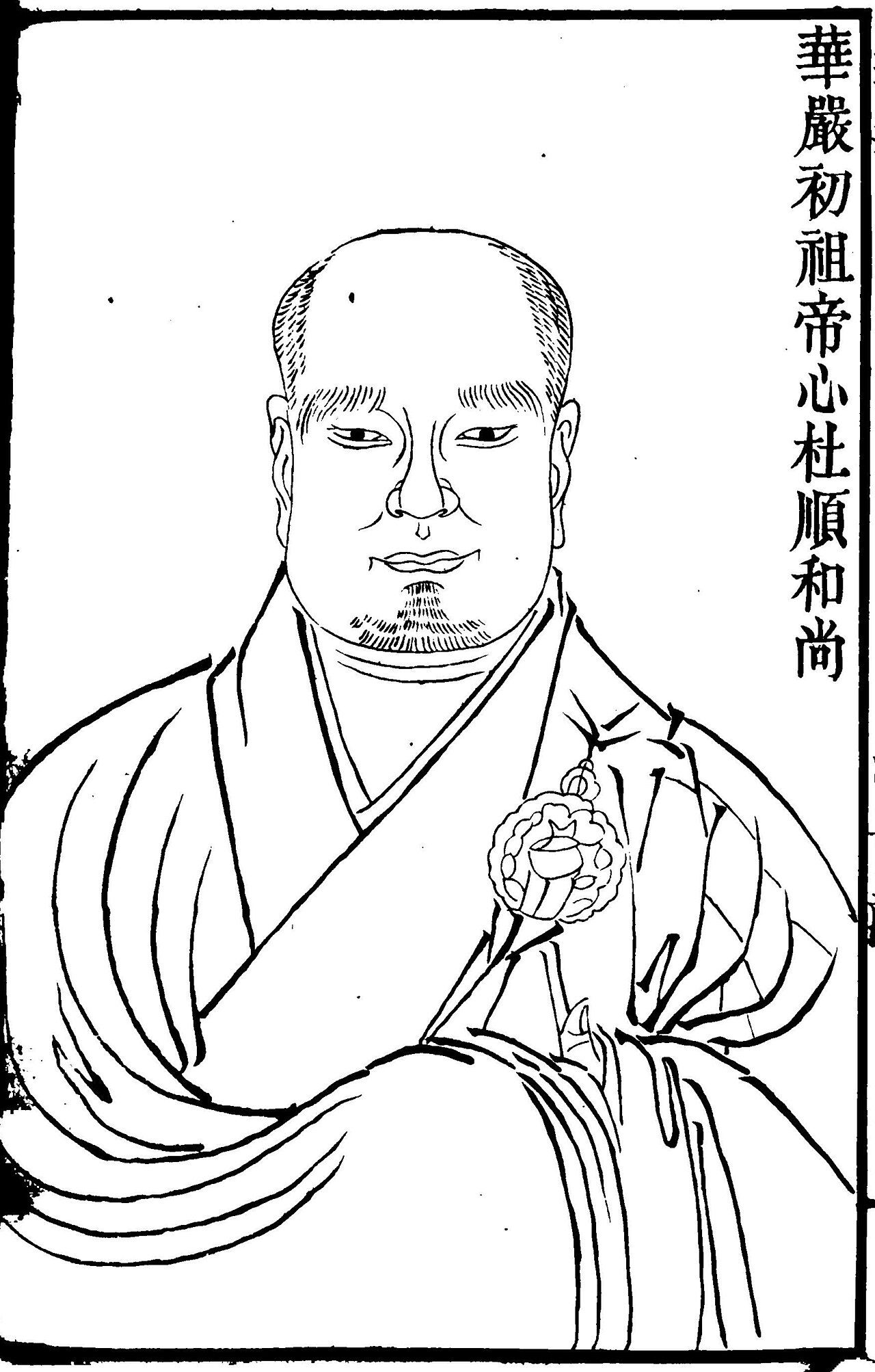
.jpg)
Dushun was a monk of the Sui and early Tang dynasties about whom little is known. He belonged to no sect, cared little for scholarly controversy, and was renowned for meditation; for some years he headed the Zhixiang Temple on Zhongnan Mountain, a centre for the study of the Avatamsaka Sutra.
He wrote only a handful of texts. His Discernments survives only inside later commentaries, notably those of Chengguan and Zongmi. Later Huayan tradition made him its first patriarch, and his student Zhiyan became the second.
Key ideas
- Reality as li
- Indian Mahayana called ultimate reality emptiness or suchness, terms that resist conception. Dushun chose the Chinese word li, pattern, for what appears in nirvana: not a void but boundless, ceaseless activity with a coherent pattern.
- Three discernments
- His Discernments of the Dharmadhatu is neither a commentary nor an exegesis. It sets out three meditations on what the Avatamsaka Sutra teaches, beginning with the familiar equivalence of form and emptiness.
- Practice for ordinary people
- Dushun’s aim was to make the sutra matter for meditation and for lay people. He ministered to the rural laity with shared meals, food for the poor, chanting and simple sermons.
- Tradition
- Chinese
- Region
- Zhongnan Mountain, China
- Themes
- What is ultimately real
Influences
Where these links come from
- Zhiyan studied with Dushun. Source: Bryan Van Norden and Nicholaos Jones, Huayan Buddhism, Stanford Encyclopedia of Philosophy
- Chengguan drew on Dushun. Source: Bryan Van Norden and Nicholaos Jones, Huayan Buddhism, Stanford Encyclopedia of Philosophy
Key works
- Discernments of the Dharmadhatu of Avatamsaka (Huayan fajie guanmen)
Sources
- Bryan Van Norden and Nicholaos Jones, Huayan Buddhism, Stanford Encyclopedia of Philosophy