Philosopher
Chengguan
738–839 CE
Fourth patriarch of Huayan Buddhism, whose commentary on the Avatamsaka Sutra displaced Fazang's, and who described reality as a fourfold dharma-realm.
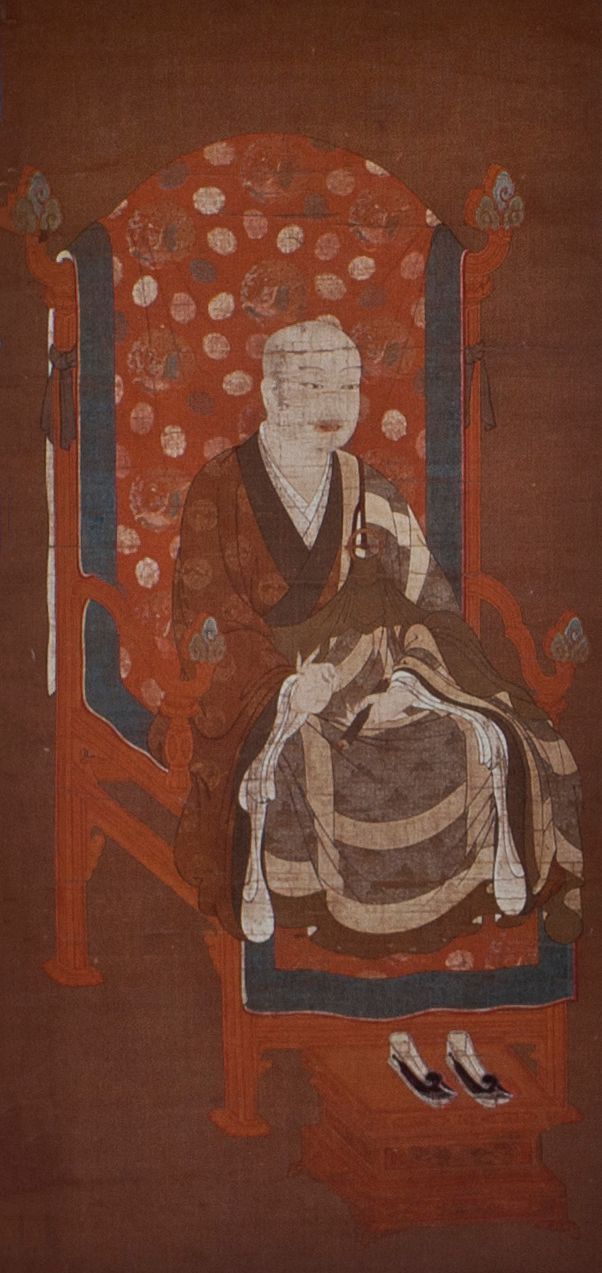
.jpg)
Chengguan’s long life spanned nine Tang reigns, and he studied widely: Buddhist doctrine and meditation, the Chinese classics, and even the Indian Vedas and Indian science. He is counted the fourth patriarch of Huayan because he studied under Fashen, a student of Fazang’s student Huiyuan.
A prolific writer, he lectured often to imperial officials and wrote many essays at their request. The Huayan monk Zongmi studied the Avatamsaka Sutra with him.
Key ideas
- The fourfold dharma-realm
- There are four ways of meeting the world of dependent arising: as particular things (shi), unreal like an illusion; as principle (li), empty, still and pure; as principle and things interpenetrating; and as things interpenetrating one another.
- Borrowing the Chinese classics
- Chengguan often quoted the Chinese classics, borrowing their words but not their meanings, to make his teaching accessible to educated officials at a time, after the An Lushan rebellion, when foreign traditions were suspect.
- An authoritative commentary
- His commentary and subcommentary on the Avatamsaka Sutra replaced Fazang’s as the authoritative reading, and his commentary on Dushun’s Discernments was also influential.
- Tradition
- Chinese
- Region
- China
Influences
Where these links come from
- Chengguan drew on Dushun. Source: Bryan Van Norden and Nicholaos Jones, Huayan Buddhism, Stanford Encyclopedia of Philosophy
- Zongmi studied with Chengguan. Source: Bryan Van Norden and Nicholaos Jones, Huayan Buddhism, Stanford Encyclopedia of Philosophy
- Uicheon drew on Chengguan. Source: Lucy Hyekyung Jee, Korean Buddhism, Stanford Encyclopedia of Philosophy
Key works
- Commentary on the Avatamsaka Sutra
Terms on this page
- shi
- Things, events or phenomena. In Huayan thought, Chengguan’s first dharma-realm is that of shi: the world met as countless distinct, conditioned particulars, unreal like an illusion.
Sources
- Bryan Van Norden and Nicholaos Jones, Huayan Buddhism, Stanford Encyclopedia of Philosophy