Philosopher
Ban Zhao
c. 45 – 116 CE
Han scholar and historian who completed the History of the Former Han and wrote Instructions for Women, a Confucian guide to the virtues of a wife.
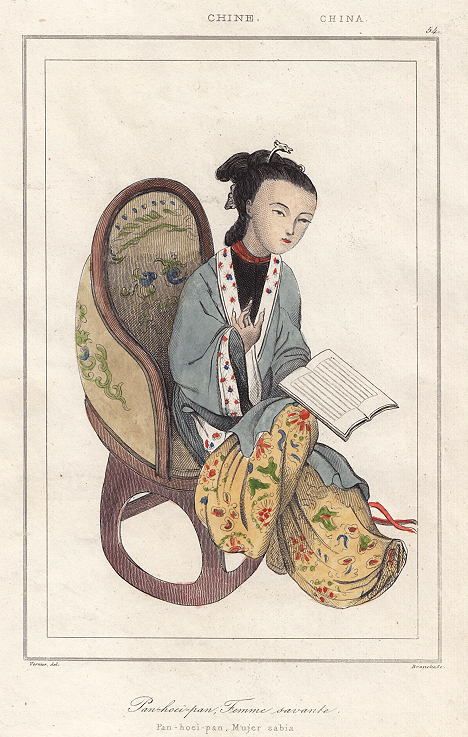

Ban Zhao’s elder brother was the court historian Ban Gu, and her great-aunt was Ban Jieyu, a concubine famed for her learning, and was raised with a learning rare for women of her day. She wrote on ethics, politics, history and astronomy.
She came from a long line of learned officials. When her brother died in prison in 92 CE, she completed his official history of the Western Han, the Han Shu.
Key ideas
- Virtue relative to role
- In line with Confucian tradition, Ban Zhao held that virtue depends on one’s role: a good ruler and a good servant show different virtues, and her Instructions for Women sets out those proper to a wife.
- Instructions for Women
- Her best-known work collects social and moral norms for women, focused on a wife’s duties to her husband and, to a lesser degree, her children.
- A woman scholar
- Her own career crossed the boundary between the inner and outer spheres that Confucian thought assigned to women and men: she became a leading scholar of ethics, politics, history and astronomy.
- Tradition
- Chinese
- Region
- Han China
- Schools
- Confucianism
- Themes
- Women and gender
Key works
- Instructions for Women (Nüjie)
- Read free at Wikisource (in Classical Chinese)
- History of the Former Han (completion) (Han Shu)
Sources
- Alexus McLeod, Philosophy in Han Dynasty China, Stanford Encyclopedia of Philosophy
- Li-Hsiang Rosenlee, Gender in Confucian Philosophy, Stanford Encyclopedia of Philosophy