Philosopher
Anna Julia Cooper
c. 1858 – 1964
Also known as Annie Haywood
Educator and philosopher whose A Voice from the South, one of the first book-length works of Black feminist thought, analysed how race, sex and class oppression intersect in Black women's lives.
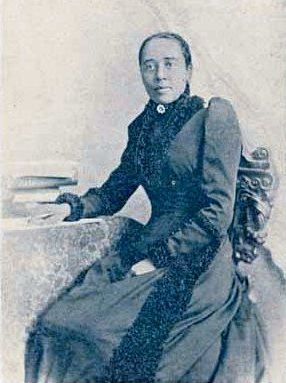

Anna Julia Cooper was born into slavery in Raleigh, North Carolina, probably in 1858; she believed her father to be her mother’s master. She began school at nine, studied for some fourteen years at Saint Augustine’s in Raleigh, where she read Latin and Greek classics, and went on to Oberlin College, earning a degree in mathematics and a master’s for college teaching. She taught for most of her life, above all at Washington’s M Street High School, which she led as principal from 1902 to 1906, and later served as president of Frelinghuysen University.
Her Voice from the South (1892) has been called the first book-length Black feminist text. In 1900 she addressed the first Pan-African Conference, in London, and in 1925, at sixty-six, earned a doctorate at the Sorbonne for a thesis on French attitudes to slavery during the Revolution, which also examined the Haitian Revolution; she was the fourth Black American woman to gain a PhD. W. E. B. Du Bois drew on her insights in Darkwater without acknowledging her. Long overlooked beside Douglass, Du Bois and Locke, she is now read as a founder of Black feminist philosophy. She died in Washington in 1964, aged 105.
Key ideas
- The voiceless witness
- In the trial over the “race problem”, lawyers have argued both sides and the jury has been charged, but one witness was never heard, the Black woman. White men cannot speak for Black men’s experience, and Black men cannot speak for Black women’s.
- “When and where I enter”
- No man can represent the race. Only the Black woman can say that when and where she enters, with undisputed dignity, “the whole Negro race enters with me”. Race uplift must be measured from the bottom, by how poor and working-class Black women live, not by an elite of Black men.
- Interlocking oppressions
- The Black woman faces at once “the woman question” and “the race problem”, and is overlooked by white women, white men and Black men alike. That position gives her a distinctive vantage point from which to see society’s systems of oppression, and a distinctive part in correcting them.
- Prejudice is sentiment
- Race prejudice is “mere sentiment governed by the association of ideas”: shifting, unreliable and impervious to reason. It is pointless to rail against it; what matters is what each people contributes to human progress, and the respect owed to difference.
- Education for a life worth living
- A liberal education gives the tools to live an examined life, not only to earn a living. Women’s higher education would add to the world the sympathy and moral force that centuries of masculine dominance had left out.
- Tradition
- African
- Region
- Washington, D.C.
- Branches
- Political philosophy
Influences
Where these links come from
- W. E. B. Du Bois drew on Anna Julia Cooper. Source: Kathryn Sophia Belle, Anna Julia Cooper, Stanford Encyclopedia of Philosophy
Key works
- A Voice from the South, by a Black Woman of the South, 1892
- Slavery and the French Revolutionists (L'attitude de la France à l'égard de l'esclavage pendant la Révolution), 1925
Sources
- Kathryn Sophia Belle, Anna Julia Cooper, Stanford Encyclopedia of Philosophy