Philosopher
Uisang
625–702 CE
Also known as Ŭisang
Silla monk who founded the Korean school of Flower Garland (Hwaeom) Buddhism, teaching that all things arise interdependently, each containing the whole universe.
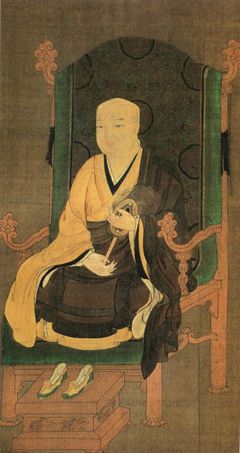

Uisang, a younger contemporary of Wonhyo, studied in China with Zhiyan, the Huayan school’s second patriarch, instead of Xuanzang, and is said to have founded the Korean Hwaeom school and bringing the philosophy of the Flower Garland Sūtra to the peninsula. While in China he composed his Diagram of the Dharma Realm, 210 characters arranged in a single distinctive shape that symbolises a mandala and sums up his thought.
Modern Korean scholars have read his “one is all, all is one” in two ways. In the 1970s historians took it as support for the authority of the Silla king over his subjects; from the 1980s Buddhist scholars read it as an expression of the equality of all beings. Both agree that it helped to unite people, and his vision of an interconnected, interdependent world has shaped Korean thought ever since.
Key ideas
- One is all, all is one
- Uisang widened the Buddhist idea of dependent origination to the whole cosmos. Each being contains the entire universe: a speck of dust holds the ten directions, and a single moment is an immeasurable age.
- The mind paints the world
- All phenomena arise from a Buddha-nature hidden but present in the mind; as the Flower Garland Sūtra says, “the mind is the world’s painter”. Though ignorance obscures it, this inner nature shapes reality, so the mind can remake the world.
- Interdependence as equality
- Uisang read the interdependence of all things as a radical equality. Despite the rigid hierarchy of Silla society, he accepted students from every background into his community and treated them alike.
- Every being is a Buddha
- His diagram ends with the Buddha seated, unmoving, at the centre of ultimate reality. Every being is a manifestation of the Buddha, able by nature to realise Buddhahood.
- Tradition
- Korean
- Region
- Silla, Korea
- Period
- Three Kingdoms and Silla
Influences
Where these links come from
- Uisang studied with Zhiyan. Source: Bryan Van Norden and Nicholaos Jones, Huayan Buddhism, Stanford Encyclopedia of Philosophy
Key works
- Diagram of the Dharma Realm of the One Vehicle of the Avataṃsaka (Hwaŏm ilsŭng pŏpkyeto)
- Read free at Wikisource (in Classical Chinese)
Sources
- Bryan Van Norden and Nicholaos Jones, Huayan Buddhism, Stanford Encyclopedia of Philosophy
- Lucy Hyekyung Jee, Korean Buddhism, Stanford Encyclopedia of Philosophy