Philosopher
Takuan Sōhō
1573–1645
Also known as Takuan Soho, Takuan
Rinzai Zen master who linked Zen with the martial experience of his samurai students, describing an 'immovable wisdom' that stays still in the midst of action.
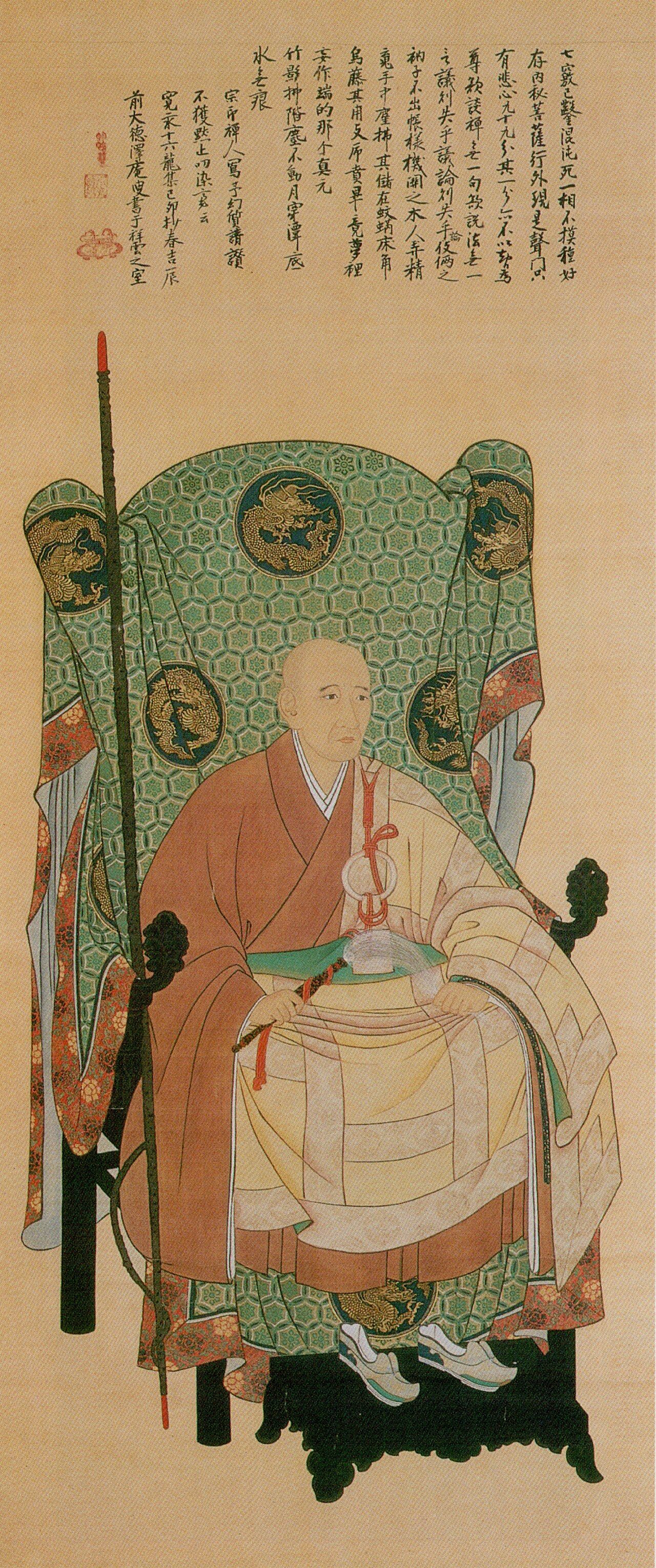

Takuan Sōhō was one of the Rinzai Zen masters, with Suzuki Shōsan and Shidō Bunan, who sought common ground between Zen and what their students, once samurai, knew of combat.
His reflections on how a mind can act freely yet remain unmoved illuminate Zen’s understanding of action.
Key ideas
- Immovable wisdom
- A mind that never stops on any one thing, moving freely in every direction, is ‘immovable wisdom’: still while it acts, as the shaft of a spinning top stays put.
- The body’s learning
- Self-cultivation is the ‘body’s learning’, in which mind and body act as one integrated whole, permeated by a psychophysical life-energy (ki) that belongs to neither alone.
- Forgetting the I
- Like Dōgen, Takuan taught that one should ‘forget the I’ in every act, whether of mind, body or speech.
Terms on this page
- ki
- Generative force, the Japanese reading of the Chinese qi: the stuff of reality in Neo-Confucian metaphysics, which Itō Jinsai made the only thing that exists, and which Kaibara Ekken urged people to nourish.
Sources
- Shigenori Nagatomo, Japanese Zen Buddhist Philosophy, Stanford Encyclopedia of Philosophy
- Thomas Kasulis and Raquel Bouso, Japanese Philosophy, Stanford Encyclopedia of Philosophy