Philosopher
Sarvepalli Radhakrishnan
1888–1975
Also known as Radhakrishnan, Sir Sarvepalli Radhakrishnan
Philosopher and statesman who presented Advaita Vedanta to the West as religion founded on intuitive experience, and later served as India's vice-president and president.
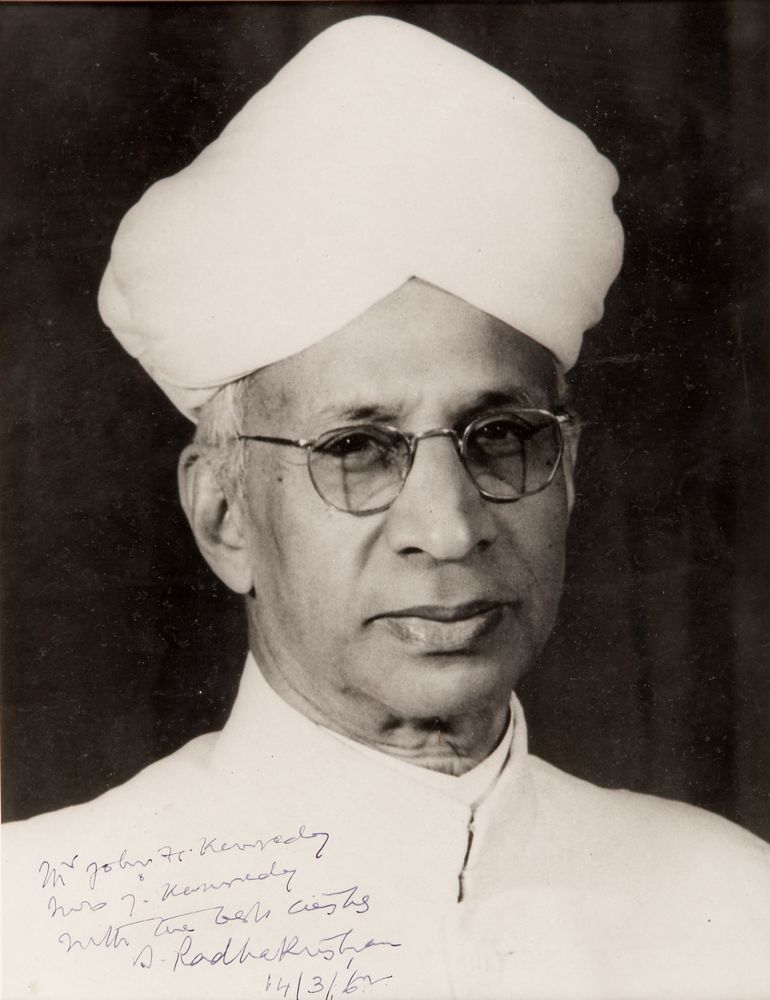

Radhakrishnan was born into a brahmin family in the temple town of Tirutani and educated at Christian missionary schools and colleges. At Madras Christian College he was trained in European philosophy, and Christian critics’ charge that Vedanta had no room for ethics prompted his master’s thesis, The Ethics of the Vedanta. He became known in Western journals in the 1910s, and in 1921 took the George V Chair of Philosophy at Calcutta, where he wrote Indian Philosophy. His Upton Lectures at Oxford became The Hindu View of Life, and his Hibbert Lectures An Idealist View of Life, his most sustained work of his own.
He was knighted in 1931, became Spalding Professor of Eastern Religions and Ethics at Oxford in 1936, and served as vice-chancellor of Andhra and Benares Hindu universities. After independence he led India’s delegation to UNESCO, chaired the commission on university education and was ambassador in Moscow, before serving as vice-president (1952–1962) and president (1962–1967) of India. Admired as a bridge between India and the West, he has also been criticised for selecting evidence to fit his account of Hinduism and for making all religions interpretations of his own Vedanta.
Key ideas
- A real world grounded in Brahman
- Radhakrishnan’s Advaita holds that the changing, finite world is not ultimate reality, yet it is real and has its source in Brahman, the Absolute that is identical with the self. Māyā is not illusion but, among other things, our misperception of the world as ultimately real.
- Intuition as integral experience
- Intuition is self-certifying, immediate and beyond words, the ground of all other experience and the source of all creativity. It integrates the other kinds of experience and works itself out in action and social life.
- Invent by intuition, prove by logic
- “We invent by intuition though we prove by logic.” Discovery is not mechanical synthesis; intuitions arise from a mastery of the facts and then have to be tested by thought. “Mere intuitions are blind while intellectual work is empty”, and there is no gulf between them.
- Religion is experience
- Religion at heart is personal experience of reality, and religions are interpretations of it; “intuitions abide, while interpretations change”. Vedanta, he claimed, is “not a religion, but religion itself”, and he ranked other forms of worship beneath it.
- Tradition
- Indian
- Region
- Madras, Calcutta and Oxford
- Schools
- Advaita Vedānta
Influences
Where these links come from
- Sarvepalli Radhakrishnan drew on Śaṅkara. Source: Michael Hawley, Sarvepalli Radhakrishnan, Internet Encyclopedia of Philosophy
- Sarvepalli Radhakrishnan drew on and argued against Henri Bergson. Source: Michael Hawley, Sarvepalli Radhakrishnan, Internet Encyclopedia of Philosophy
Key works
- Indian Philosophy, 1923
- The Hindu View of Life, 1927
- An Idealist View of Life
Terms on this page
- māyā
- The creative or magical power by which, in Advaita Vedānta, the one reality appears as a world of many things. Gauḍapāda held that all dualities are projected by māyā and do not really exist.
Sources
- Michael Hawley, Sarvepalli Radhakrishnan, Internet Encyclopedia of Philosophy