Philosopher
Léopold Sédar Senghor
1906–2001
Also known as Leopold Sedar Senghor
Senegalese poet, statesman and philosopher, a founder of Négritude, who read in African religions an ontology of vital forces and gave the movement its philosophy.
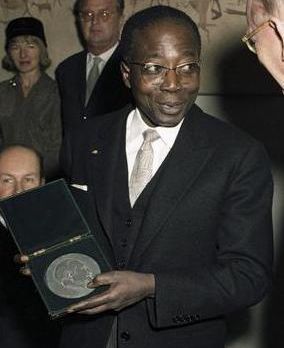

Léopold Sédar Senghor came to Paris from Senegal as a student in the late 1920s, where he met Aimé Césaire from Martinique and Léon-Gontran Damas from French Guiana. Together they turned their individual revolt as colonial subjects into Négritude, a concept meant to unite all Black people, meeting writers of the Harlem Renaissance at the Paris salon of the Nardal sisters.
His 1939 essay ‘What the Black Man Contributes’ was his first important theoretical statement. Elected a deputy for Senegal in 1946, he sat in the French Parliament with the Socialists. He died in 2001.
Key ideas
- An ontology of vital forces
- Unlike Césaire and Damas, Senghor held that Négritude was a philosophy, to be read in Africa’s cultures and religions, which rest on an ontology of life forces: vital force, given by God to people, animals, plants and minerals alike, is what makes them be.
- Emotion and reason
- His most controversial formula, ‘emotion is Negro, as reason is Hellenic’, was attacked for echoing Lévy-Bruhl’s division between rational Western societies and a supposedly primitive mentality.
- A philosophy of life
- Senghor found in Tempels’ Bantu Philosophy and Bergson’s philosophy of the vital impulse the language of a life philosophy that he took to be characteristic of African cultures.
- Tradition
- African
- Region
- Senegal and Paris
- Themes
- What is ultimately real
Influences
Where these links come from
- Léopold Sédar Senghor drew on Henri Bergson. Source: Souleymane Bachir Diagne, Négritude, Stanford Encyclopedia of Philosophy
Key works
- What the Black Man Contributes, 1939
Sources
- Souleymane Bachir Diagne, Négritude, Stanford Encyclopedia of Philosophy